Sick pay continuation: Bern, Basel & Zurich scales explained
Your cleaner calls in sick - how long do you keep paying? In the first year of service, it's 3 weeks everywhere. From the second year, the scales diverge - 8 weeks in Zurich, 1 month in Bern, 2 months in Basel. Most employers don't know which scale applies to them until they actually need to know.
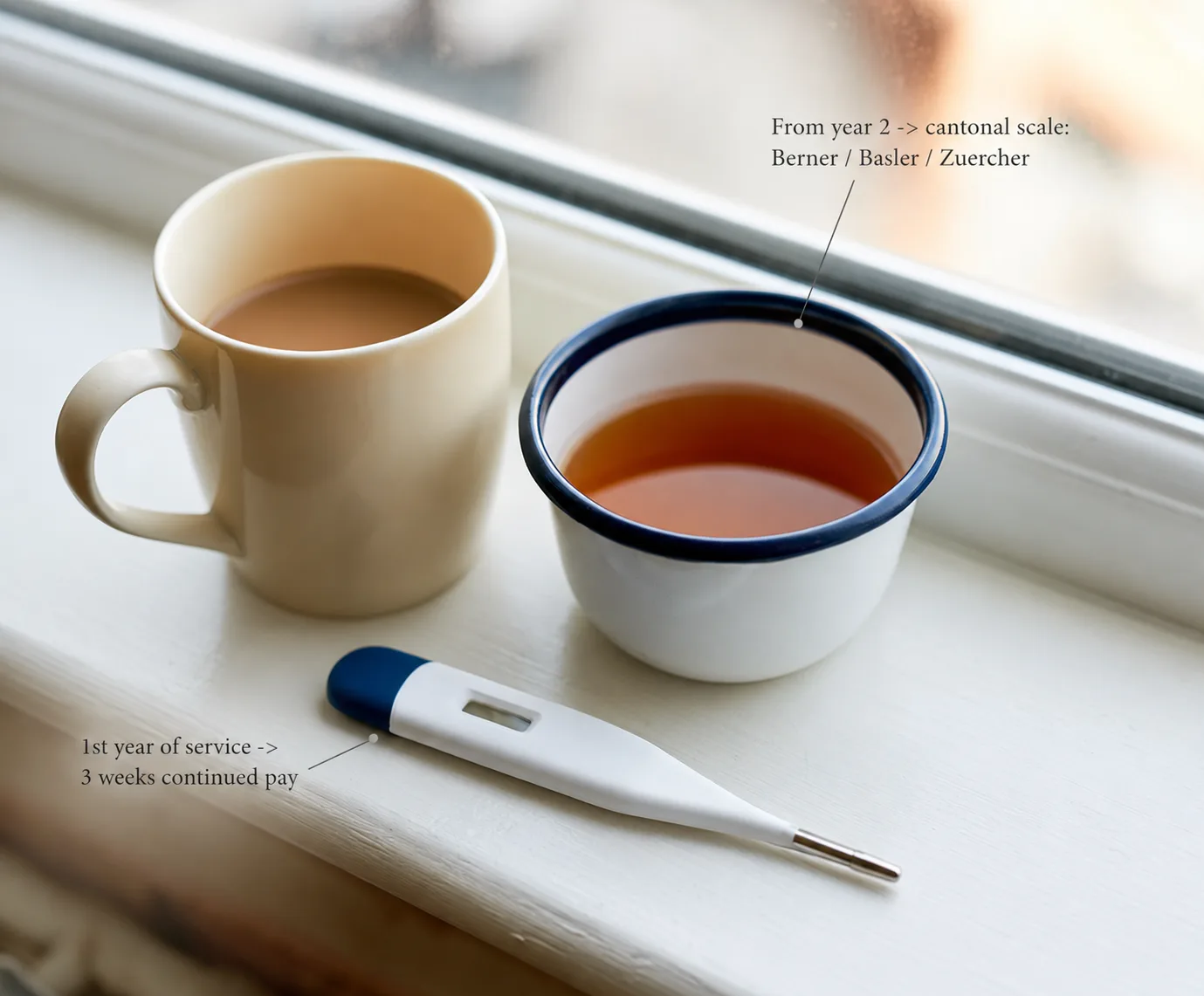
In the first year of service you generally continue paying wages for 3 weeks - from the second year the duration increases with the cantonal scale (Bern, Basel or Zurich) and years of service.
- Bern scale (majority of cantons): 3 weeks in year 1, 1 month in year 2
- Basel: 2 months from year 2, Zurich: 8 weeks - the place of work decides
- KTG insurance: mandatory in 15 cantons, optional in 5, up to 720 days at 80%
Berner Skala
How long does the wage keep running?
The longer the employment, the longer the 100% sick pay. The Bern scale applies in most cantons.
- Year of service 121 days· 3 weeks
- from year 230 days· 4 weeks
- from year 360 days· 9 weeks
- from year 590 days
- from year 1017 weeks120 days
- from year 1521 weeks150 days
- from year 2026 weeks180 days
Basel and Zurich use scales of their own, some cantons the table of their standard employment contract. The calculator below knows them all.
Legal basis: Art. 324a CO
The obligation to continue paying wages during illness is enshrined in Art. 324a of the Swiss Code of Obligations (CO). The article states: the employer must continue paying the employee's wages for a limited period in case of involuntary inability to work - including illness.
This obligation applies once the employment has lasted more than three months or was entered into for more than three months (Art. 324a para. 1 CO). For open-ended employment it therefore applies from the first working day - including during probation. Only fixed-term engagements of up to three months are exempt.
Art. 324a CO does not specify fixed durations. Instead, the law refers to a "limited period" relative to the duration of the employment relationship. In practice, courts have developed three scales that serve as guidelines.
Continued pay is only one of your duties when your cleaner is sick - our detailed guide covers the medical certificate, the notification and the other practical steps.
Important for private households
The three scales compared
Swiss courts apply one of three scales depending on the canton. All three are based on years of service but differ significantly in generosity.
Bern scale (most widely used)
The Bern scale is considered the standard and is applied by the majority of cantons. It is the oldest and most frequently cited scale.
| 1st year | 3 weeks |
| 2nd year | 1 month |
| 3rd-4th year | 2 months |
| 5th-9th year | 3 months |
| 10th-14th year | 4 months |
| 15th-19th year | 5 months |
| 20th+ year | 6 months |
Basel scale (most generous from the 2nd year)
The Basel scale is significantly more employee-friendly from the 2nd year of service. It is primarily applied in the cantons of Basel-Stadt and Basel-Landschaft.
| 1st year | 3 weeks |
| 2nd year | 2 months |
| 3rd year | 2 months |
| 4th-10th year | 3 months |
| 11th-15th year | 4 months |
| 16th-20th year | 5 months |
| 21st+ year | 6 months |
Zurich scale
The Zurich scale falls between the Bern and Basel scales. It is applied in the canton of Zurich and some other cantons.
| 1st year | 3 weeks |
| 2nd year | 8 weeks |
| 3rd year | 9 weeks |
| 4th year | 10 weeks |
| 5th-9th year | +1 week/year |
| 10th-14th year | +1 week/year |
| 15th+ year | +1 week/year |
The Zurich scale increases linearly: 11 weeks in the 5th year, 16 weeks in the 10th year, 21 weeks in the 15th year, etc.
Bern & Zurich scale
- •Bern scale: 1 month, Zurich scale: 8 weeks
- •Applies in the majority of cantons
- •Limited coverage in the early years
Basel scale
- •Already 2 months of continued pay
- •Applies in Basel-Stadt and Basel-Landschaft
- •Significantly better employee protection
Which canton uses which scale?
The assignment is not defined by law but results from court practice. Here is an overview:
Bern scale
Bern, Lucerne, Uri, Schwyz, Obwalden, Nidwalden, Glarus, Zug, Fribourg, Solothurn, Appenzell Ausserrhoden, Appenzell Innerrhoden, St. Gallen, Graubünden, Aargau, Ticino, Vaud, Valais, Neuchatel, Geneva, Jura
Basel scale
Basel-Stadt, Basel-Landschaft
Zurich scale
Zurich, Schaffhausen, Thurgau
Calculation examples with real numbers
To make the scales tangible, here are three concrete scenarios:
Calculate continued sick pay
Pick canton and year of service. You instantly see how long the wage keeps running during illness.
At full pay (100%), per illness in that year of service. With daily-sickness-benefit insurance (KTG) it usually runs longer, but at 80%.
Example 1: Cleaner in Bern, 1st year of service
Maria has been working as a household helper for 8 months, 6 hours per week, CHF 30/hour. She falls ill for 4 weeks.
The 4th week is not covered. Maria receives no pay for that week unless a KTG insurance is in place.
Example 2: Household helper in Basel, 2nd year of service
Ana has been working in the household for 14 months, 10 hours per week, CHF 28/hour. She falls ill for 6 weeks.
The entire 6 weeks are fully covered. The Basel scale offers significantly more protection here.
Example 3: Nanny in Zurich, 5th year of service
Laura has been working as a nanny for 4.5 years, 20 hours per week, CHF 32/hour. She falls ill for 3 months.
The last 2 weeks are not covered. Total cost for the employer: approx. CHF 7,040.
The longer the employment relationship, the longer the sick pay - but differences between cantons can amount to several months.
Daily sickness benefit insurance (KTG): mandatory in 15 cantons
Daily sickness benefit insurance can replace the statutory sick pay under Art. 324a CO, provided it is equivalent or better. In practice, this is almost always the case, as KTG policies standardly offer 720 days of benefits.
Whether you MUST take one out is decided by the standard employment contract of the canton where the work happens. Fifteen cantons, among them Zurich, Bern, Lucerne, St. Gallen, Solothurn and Geneva, require it. Five more expressly leave it to you, and six have no such rule at all. Where it is mandatory, going without does not merely leave you carrying the risk: you are liable for exactly the benefits the policy would have paid.
When does KTG insurance make sense?
- ✓From the 2nd year of service - the risk increases with the years
- ✓With more than 8 hours per week - higher wage costs in case of illness
- ✓For nannies and full-time household helpers - often high monthly wage costs
- ✓If you want planning certainty - fixed premium instead of unexpected sick pay
Without KTG (Art. 324a CO)
- •Duration depends on scale and years of service
- •Employer bears full risk
- •3 weeks to 6 months
- •100% of wages
- •No premiums but unplannable risk
With KTG insurance
- •Up to 720 days coverage
- •Insurance bears the risk
- •Waiting period: usually 30 or 60 days
- •80% of wages
- •Premium approx. 1-3% of gross wage
Important with KTG
How Clino helps with sick pay
Clino automates sick pay calculation for your private household:
Clino automatically detects the canton and applicable scale
Years of service are continuously tracked
In case of illness, Clino calculates the exact sick pay duration
The payslip correctly shows the continued pay
You receive a reminder when the end of sick pay is approaching
Start in your canton
All details on compensation office, contributions and registration.


Frequently asked questions
How long must I continue paying my cleaner's wages during illness?
This depends on years of service and canton. Under the Bern scale (majority of cantons), it is 3 weeks in the 1st year, 1 month in the 2nd year, 2 months from the 3rd year, etc. In Basel-Stadt and Basel-Landschaft, the Basel scale applies: also 3 weeks in the 1st year, but more generous afterwards (2 months in the 2nd-3rd year, 3 months from the 4th year).
What is the Bern scale for sick pay?
The Bern scale is a guideline developed by case law for the duration of sick pay under Art. 324a CO. It starts at 3 weeks in the 1st year of service and increases in stages to 6 months from the 20th year. It is applied in most Swiss cantons.
Bern scale sick pay table - which duration applies?
1st year: 3 weeks, 2nd year: 1 month, 3rd-4th year: 2 months, 5th-9th year: 3 months, 10th-14th year: 4 months, 15th-19th year: 5 months, 20th+ year: 6 months. These values apply per illness and year of service.
Is daily sickness benefit insurance worth it for my household employee?
In 15 cantons the question does not arise: the cantonal standard employment contract requires the cover. Where it is optional, it pays off especially from the second year of service. The premium is around 1-3% of gross wages, is usually split in half, and covers up to 720 days at 80% of the wage. That is considerably more than statutory sick pay.
Does sick pay also apply with hourly wages?
Yes. Even with hourly wages, the full sick pay obligation applies. The average wage over the last 12 months (or since the start of employment, if shorter) is decisive. Holiday compensation must also be included in the calculation.
What happens when sick pay is exhausted?
After the sick pay period expires, the employer has no further payment obligation. The employee may be able to claim benefits from health insurance (daily allowance, if privately insured) or social assistance. KTG insurance would continue paying for up to 720 days in this case.
Free Checklist: Hire Household Help Correctly
AHV, accident insurance, contract. All on one page, by email in 30 seconds.
No spam. Unsubscribe anytime.
Further reading
Sources & further information
- 1CO Art. 324a - Continued payment of wages in case of employee's inability to work. fedlex.admin.ch
- 2NAV Hauswirtschaft (SR 221.215.329.4). fedlex.admin.ch
- 3Federal Supreme Court - Case law on sick pay scales. bger.ch
- 4SECO - Labour law and employment relationships. seco.admin.ch
Calculate sick pay automatically
Clino knows the correct scale for your canton and calculates sick pay automatically. No looking up, no errors. Try it with our cost calculator.
Legal notice: This article provides general information on sick pay continuation and the various scales in Switzerland. It does not replace legal advice. The exact provisions may vary depending on the canton, employment contract and individual case. For specific questions, please consult a specialist. Information is based on Art. 324a CO, as of 2026.
