Undeclared work in Switzerland: what you really risk, and how to avoid it in 10 minutes
Most households that pay cash and skip the registration think: nobody will ever notice. Usually that holds, until the cleaner has an accident, falls ill, or there is a row about money. Then it gets expensive fast: back-payment of contributions over up to five years, 5% default interest, and in an accident the substitute premiums claimed by the UVG substitute fund.
Penalties at a glance (Switzerland 2026)
Four risks, one conclusion: registering is always cheaper than any fine.
- max. CHF 10,000
Administrative fine (AHVG Art. 88)
Per offence
- Monetary or custodial penalty
Criminal prosecution
AHVG Art. 87, AIG Art. 117
- up to 5 years retroactive
AHV back-payments
Plus 5% default interest
- up to 3× tax owed
Tax penalty (DBG Art. 175)
Plus 10-year back tax
The legal comparison: your employer contributions come to roughly 8-10% of the wage. No fines, full cover from day one.
What counts as undeclared work in Switzerland?
Undeclared work is precisely defined by Swiss law. Under the Federal Act on Measures to Combat Undeclared Work (BGSA) (Source: BGSA) undeclared work occurs when:
- !No registration with the compensation office: You pay someone for work in your home without registering them. Domestic service has no de-minimis threshold. The duty starts with the first franc.
- !No social-security contributions: AHV/IV/EO and ALV are never settled. It is the employer, you, who owes them to the office, including your employee's share.
- !No accident insurance: There is no UVG cover. It is compulsory from the first hour worked and cannot be taken out retroactively.
- !Wrong or incomplete declarations: The wage is declared too low, or an employment relationship is passed off as self-employment when it is not one.
- !No permit: The person has no valid residence or work permit. That is the variant that turns criminal fastest (AIG art. 117).
Particularly tricky: many households believe their cleaner is "self-employed" - but in practice, it is almost always an employment relationship. Learn more in our article about bogus self-employment for cleaners.
An often overlooked special case: even a Christmas bonus or gratuity handed over «on the side» in cash is wage - and thus undeclared work on that amount. How to pay a bonus correctly and voluntarily is explained in our article on the gratuity in the private household.
Penalties for undeclared work: fine up to CHF 10'000
How undeclared work gets discovered
It does - and almost never at a convenient moment. These are the five most common ways an unregistered job comes to light.
- TriggerWork accidentWhat happens nextThe hospital and Suva ask for the accident insurance - which doesn't exist.
- TriggerWage dispute or dismissalWhat happens nextThe employee contacts the compensation office.
- TriggerA later AHV or IV claimWhat happens nextThe missing contribution years stand out and get traced back.
- TriggerDivorce or inheritanceWhat happens nextCash payments surface in bank statements and receipts.
- TriggerTax audit or anonymous reportWhat happens nextAn inspection under the BGSA is triggered.
There is only one path that never comes out: register properly.
Register properly nowAnyone caught in an inspection pays three times over: fine, tax penalty and back-payment of contributions. The rates in the law:
Sources: AHVG Art. 88 · DBG Art. 175 · AHVG Art. 16
The most expensive item is usually not the fine but the back-payment. The compensation office recalculates the contributions on the actual wage, up to five years back and with 5% default interest, and it claims the full contribution from you, your employee's share included. How large it gets depends purely on the wage and the duration. The calculator above works out your case.
Insurance gaps: no protection in case of accident or illness
The expensive case is the accident. If your cleaner is registered, the accident insurer carries the consequences. If she is not, you do:
With UVG cover:
Treatment costs, daily allowances and, in case of invalidity, the pension all run through the insurer. For you the matter ends there. (Suva)
With AHV registration:
Your employee builds up contribution years towards her pension, and you hold the proof that you met your duties as an employer. (AHV Merkblatt 2.06)
Without registration:
The UVG substitute fund pays the injured woman the statutory benefits and then reclaims substitute premiums from you for the whole period of the breach, up to five years and doubled if you evaded the duty inexcusably (art. 95 UVG). Insuring retroactively is no longer possible at that point.
What happens in a real emergency is shown by a concrete example: if your cleaner has an accident without insurance, the Ersatzkasse UVG pays - and charges you as the employer substitute premiums. More in the article Cleaner injured without insurance - who pays?
And tax? Who is hit by what
A lot gets mixed up here. Your cleaner's wage is not a business expense your private household could be evading tax on. The tax risk sits elsewhere:
- $For your employee: She has to declare the wage. Without a registration she has no document proving it, and the back-tax plus evasion penalty (DBG art. 175) falls on her, not on you. (Quelle: BSV)
- %For you, if you claimed a deduction: Some cantons allow household-help or childcare costs to be deducted. Claiming such a deduction while never having registered the person risks back-tax and a penalty on exactly that deduction. (BSV)
- !Under the simplified procedure: You deduct the 5% withholding tax from the wage and pass it to the compensation office together with the contributions. That settles your employee's income tax on this wage. For her, that is the real upside of being registered.
- 3xDefault interest: Contributions and taxes paid late accrue roughly 5% a year, which is why waiting makes the bill grow month by month. (DBG Art. 175)
By the way: if you register your household help correctly, you can claim the costs in your tax return and deduct cleaning costs from your taxes. For foreign employees, withholding tax also applies - something completely ignored with undeclared work.
The bill comes later.
A rough, honest estimate of the AHV contributions you would owe if you were audited. Set up your case:
Hourly wage (guideline)
Retroactive AHV/IV/EO + ALV owed
Employer and employee share combined, you are liable for both.
Possible fine range (guideline)
Late interest and fines are cantonal and vary a lot. Only a rough indication, not an assessment.
The real damage is usually not the AHV, but that your cleaner stood there without accident insurance and without pension contributions. That part cannot be fixed retroactively.
Registering properly costs CHF 19.90 a month, flat. Clino prepares the AHV registration, the payroll and the contract, and walks you through filing it. 30 days free, nothing is charged before day 30.
Register, nothing charged before day 30 Or start with just the contract: create it free, no account →More on this: paying your cleaner in cash →Illustrative estimate, not legal or tax advice. Calculated with AHV/IV/EO 10.6% and ALV 2.2% (employer plus employee share) on the estimated gross wage of the period, max. 5 years retroactive. Hourly wages are NAV guideline values, varying by canton. UVG, FAK, withholding tax, late interest and fines are not fully reflected here. (As of 2026)
CHF 170 a month - or a four-figure hit all at once
Example: family with a cleaner, 6 hrs/week, 2 years.
CHF 19.90 Clino + approx. CHF 100–200 social contributions · full insurance cover
Without registration (illegal)
- •Fines plus tax penalties
- •No accident insurance coverage
- •Tax back payments + late interest
- •No OASI pension, no loans possible
With Clino (legal)
- •Registered by the book from day 1
- •AIA, OASI, DI: everything automatically covered
- •Correct tax accounting included
- •Pension building, creditworthiness, security
Registering pays off - for both sides
Doing it properly isn't a tedious chore. It brings concrete benefits - to you as the employer and to the person working for you.
For you as the employer
- Insured, not liableIf an accident happens at your home, insurance pays - not you out of pocket.
- Save on taxesPart of the cost is deductible from your taxes.
- Legal certaintyNo fines, no back-payments, peace of mind.
- A reliable relationshipFairly employed staff stay longer and recommend you.
- No paperworkClino prepares the contract, payroll and registration for a flat CHF 19.90/month.
For the employed person
- Pension & AHVEvery declared wage counts toward the future pension.
- Accident & sicknessInsured from hour one; pay continues when ill.
- Unemployment & maternityEntitled to unemployment benefits and maternity allowance.
- Proof of incomePayslips for renting a flat, getting credit or a residence permit.
- Holidays & protectionAt least 4 weeks of paid holiday and statutory notice protection.
Proper employment isn't a burden - it's security for both sides.
Register properly nowHow to legalize undeclared work
The good news: there are legal ways to regularize previous undeclared work, including through the simplified settlement procedure (FSIO simplified procedure). You have to approach the office yourself, and that is exactly what makes the difference between instalments and penalties:
Contact the compensation office
Call the compensation office of your canton of residence and register the employment after the fact. Coming forward before an inspection does means negotiating instalments rather than penalties.
Settle the open contribution years
The office works out which years still have contributions outstanding, five at most. Payment by instalments is common, but you have to ask for it.
Take out accident insurance immediately
A UVG policy runs from the day you take it out, never backwards. This is the step that removes the biggest risk from today onwards. Do it first.
Complete formal registration
After that it runs like any employment: a written contract, registration with the compensation office, a monthly payslip. Registering a household employee costs no fees at all.
Moving from cash to registered
Maria
online
Hi Maria, I want everything in our home to be above board. I'll register you officially from next month, your hourly wage stays the same, and I'll cover the contributions as the employer. That way you're protected for accidents and illness.
18:10Oh, that's kind, thank you! Does anything else change for me?
18:25Only for the better: you get a payslip and are properly insured. I'll take care of the registration.
18:28Already paying someone without registration? Ask us discreetly on WhatsApp
A real person answers, usually the same day: how to get compliant, what it costs and how to explain it to your cleaner. No obligation, no blame.
The simple solution: which procedure applies to you
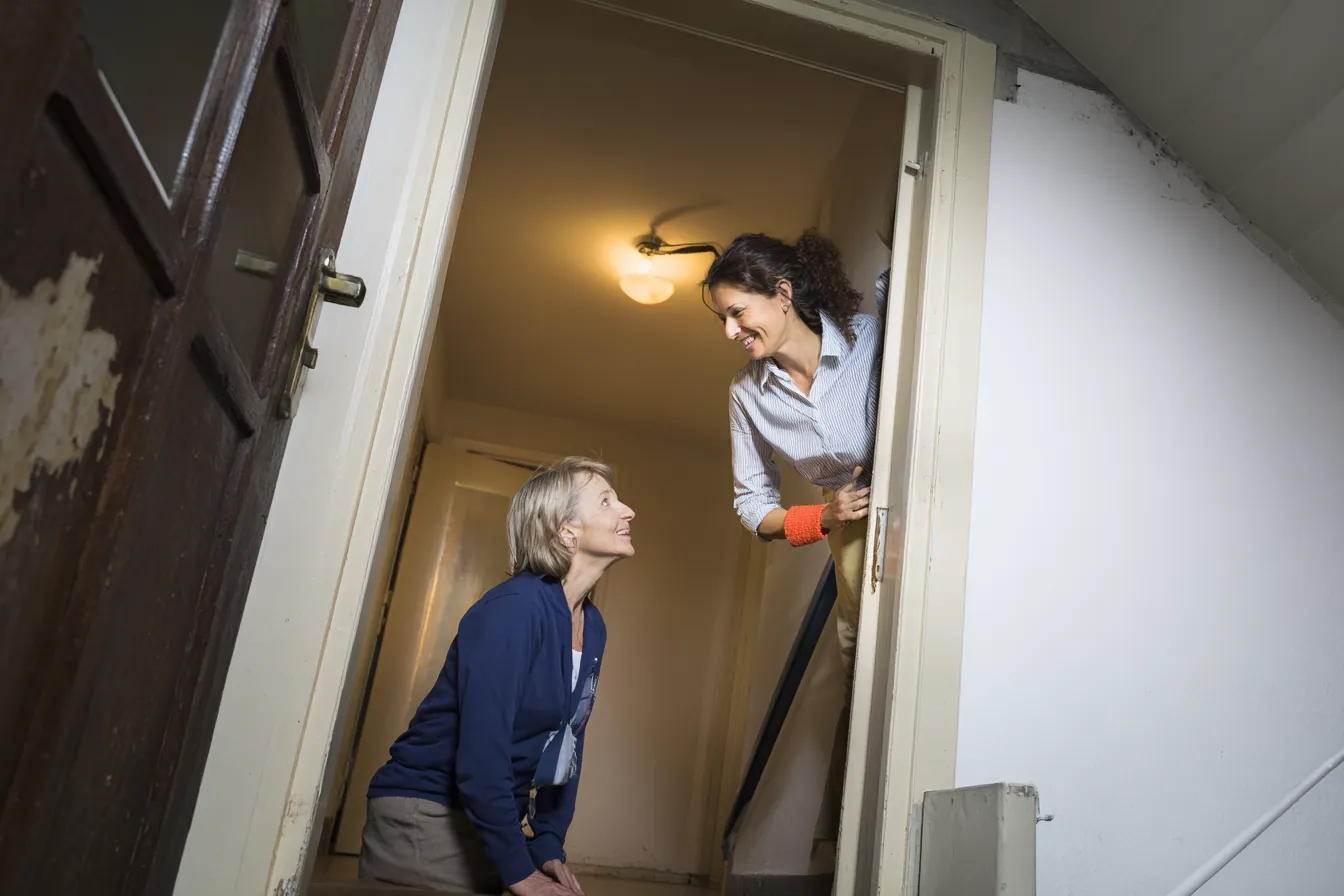
Honestly, the Swiss state makes this unnecessarily hard for private households. No single point of contact, five different insurances, cantonal variations. It's absurd bureaucracy for someone who comes two hours a week. That doesn't change the liability. And the liability is real.
For a private household there are exactly two statutory procedures, plus one variant in which you never become the employer at all:
Why registering pays off
Peace of mind
No more risk that an accident or an argument about money unravels the whole thing. That is the real gain.
Full cover from day one
Occupational accidents from the first hour, non-occupational from 8 h/week, and the claim then belongs to the insurer, not to you.
Your employee is protected
Contribution years towards the AHV, entitlement to unemployment and maternity benefits: none of it exists before the registration.
You can prove what you paid
The contract and the payslips are your evidence, including towards the tax office, if your canton allows a deduction for household help.
Not much work
The first registration takes an hour or two. After that it is one payslip a month and one declaration a year.
Your options at a glance:
Simplified settlement procedure (up to CHF 22,680 a year)
The normal case in a private household: one settlement a year with the compensation office, the 5% withholding tax included. Clino prepares the contract, the registration and the payslips and walks you through each step. You remain the employer and you file.
Ordinary procedure (from CHF 22,680 a year)
Above that annual wage you settle quarterly, occupational pension (BVG) joins in, and your employee declares the wage herself. More paperwork, same logic.
Through a cleaning company (you never become the employer)
You book a company instead of employing someone. The company then carries every employer duty. In exchange you pay the company rate and usually get changing staff. Here is how to register yourself instead.
What does not work: treating her as self-employed
A cleaner who works only for you, uses your equipment and follows your schedule is an employee, even if she writes an invoice. Whether someone is self-employed is decided by the compensation office, not by the arrangement between the two of you.
Checklist: How to stay on the safe side
Your Compliance Checklist
Start in your canton
All details on compensation office, contributions and registration.


Frequently asked questions
What fines can I expect for undeclared work in Switzerland?
Does undeclared work affect my insurance coverage?
Can I retroactively register my domestic worker?
How do authorities detect undeclared work?
What is the difference between undeclared work and legal employment?
How far back can the compensation office claim contributions?
Conclusion: Undeclared work costs more than it saves
Undeclared work saves a few francs in the short run and postpones the risk to the day something happens: an accident, an illness, an argument about money. Then it all arrives at once: back-payment of contributions over up to five years, 5% default interest, a fine, and in an accident the substitute fund's premiums.
And it can be put right at any time. Approach the compensation office yourself and you negotiate instalments, not penalties.
The first step: register your cleaner properly - our guide shows you how in just 5 steps.
Who works in your home?
Registration differs slightly by profile. Pick your guide:
Or go straight to your canton: Register household help - all 26 cantons
Further reading
Ready for the legal alternative?
Clino prepares the contract, the registration and the payslips and walks you through every step. You file and you stay the employer, and you always know what is still open. Calculate your costs with our Cost calculator or compare Clino vs. Quitt.
Working without a contract?
We help you for free to understand your work situation and get things sorted. Write to us or leave your details. We'll get back to you personally.
One quick thing: where are you right now?
Legal notice: This article provides general information about undeclared work in Switzerland. It does not replace legal advice. Exact penalties and regulations may vary by canton. For specific questions, please consult a tax advisor or lawyer. The information is based on the Federal Act on Measures to Combat Undeclared Work (BGSA), as of 2026.
