UVG Accident Insurance for Domestic Workers: The Complete Employer Guide
Accident insurance (UVG) is mandatory for all employees in Switzerland – including your cleaner or domestic helper. Ignoring this obligation risks fines up to CHF 10'000 and substitute premiums from the Ersatzkasse UVG up to 5 years back. This guide explains everything: BU vs. NBU, the 8-hour rule, VAVplus/SOLIDA, and how to get covered for around CHF 100 per year.
Your cleaner works 4 hours per week at your home. On Tuesday, she slips on the wet bathroom floor and breaks her wrist. Hospital stay, surgery, weeks of physiotherapy. Do you have UVG insurance? If not, YOU pay – everything.
Accident insurance (UVG) is mandatory for every domestic worker in Switzerland - from the very first hour of work. The employer always pays the premium for occupational accidents; the employee pays the non-occupational part once they work at least 8 hours a week. Since 2025, the VAVplus scheme makes it easy to arrange through the compensation office.
This applies when
For anyone who privately employs domestic help, a cleaner, a nanny or a carer - the UVG duty applies from the first franc of wage, no matter how few the hours.
Official sources
More on insuring your household help: Insuring a cleaner: all mandatory insurances & costs·VAVplus: UVG cover via the Ausgleichskasse·Find your UVG insurer: calculator & wizard·Sick-pay insurance (KTG): where it is mandatory
What happens after an accident
Day 1
Accident
At work or on the way to work
From day 1
Treatment costs
Doctor, hospital, therapy: 100%, no deductible
From day 3
Daily allowance
80% of the wage until she can work again
Long-term
Pension
For disability, or for survivors in case of death
Without a policy the Ersatzkasse UVG pays the benefits anyway and bills you replacement premiums for up to five years, double if inexcusable (Art. 95 UVG).
What Is UVG Accident Insurance?
The Accident Insurance Act (UVG) is a federal law that protects all employees in Switzerland against the consequences of occupational and non-occupational accidents, as well as occupational diseases. It is a pillar of the Swiss social security system.
Legal basis: Federal Act on Accident Insurance (UVG, SR 832.20), in force since 1984
Applies to ALL employees – including part-time, hourly wage and private households
Covers medical costs, daily allowance, disability and survivor pensions
Carriers: Suva (for certain industries), private insurers or health funds with UVG licence
Who Needs UVG Insurance?
Short answer: every employer in Switzerland. The detailed answer depends on the workload:
Cleaner, housekeeper or domestic helper – BU mandatory from the 1st working hour
Babysitter, nanny, au pair – UVG mandatory like any other employment
Gardener, caretaker, care assistant – all count as employees in a private household
Even part-time workers paid hourly are full employees under UVG law
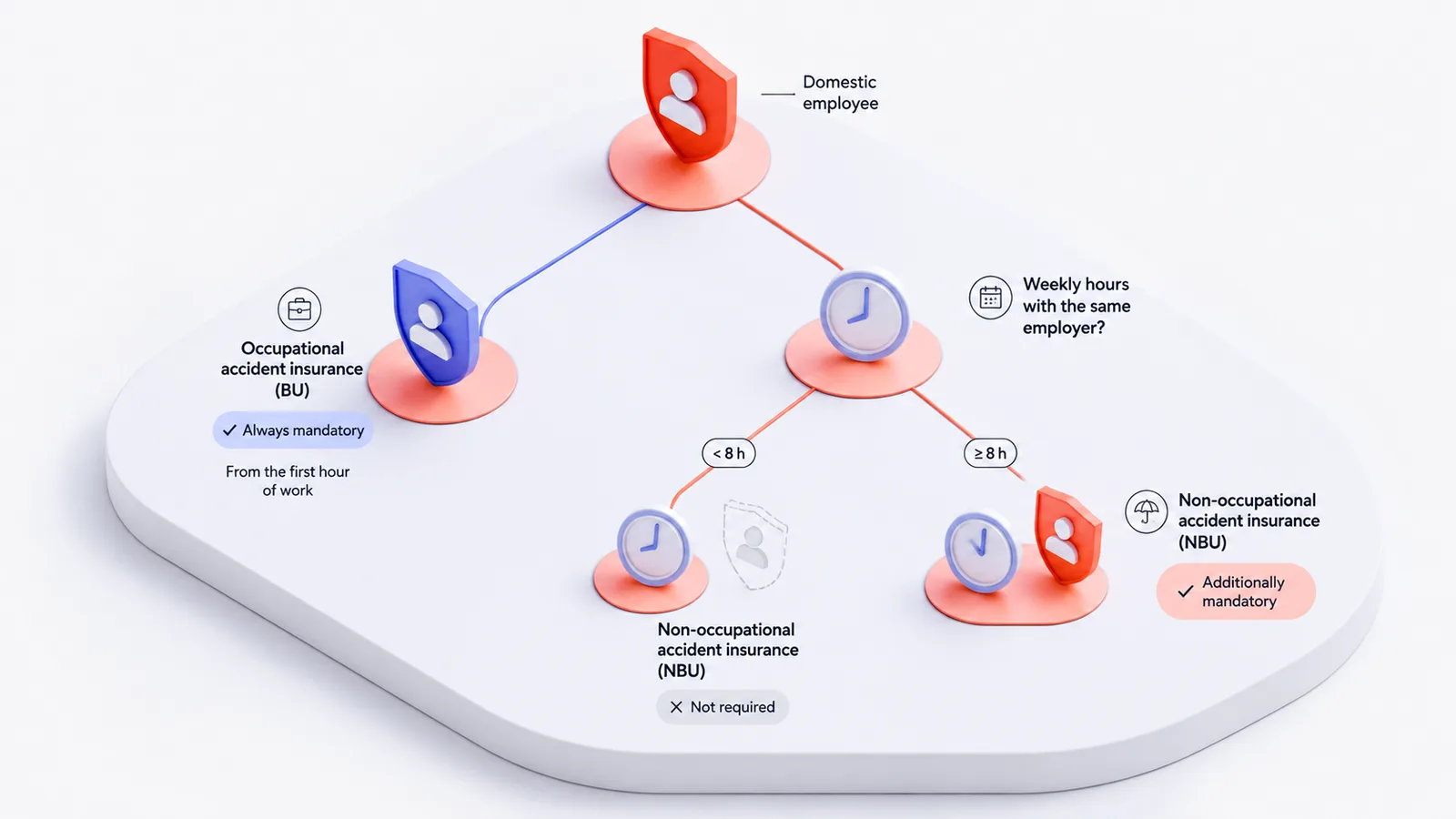
BU vs. NBU: The Two Pillars of Accident Insurance
The UVG distinguishes two categories of accidents – and the rules differ:
Occupational Accident (BU): Also covers occupational diseases
So what applies in your case?
Less than 8 hrs/week with you
You only insure occupational accidents. If something happens in her free time, her health insurer takes over.
8 hrs/week or more with you
You insure occupational and non-occupational accidents. You may deduct the NBU premium from her wage.
Understanding the 8-Hour Rule: Important: The 8-hour threshold refers to working hours with a single employer. If your cleaner works 4 hours with you and 5 hours with another household, the NBU obligation only applies to the second employer.
What Does UVG Insurance Cover?
UVG benefits are comprehensive and defined by law. Here are the four pillars:
Medical costs
Doctor, hospital, medication, physiotherapy, aids – no deductible, no co-payment. Unlimited.
Daily allowance
80% of the insured salary from day 3 after the accident. The first 2 days are paid by the employer at full salary (waiting period).
Disability pension
For permanent impairment: pension of up to 80% of insured salary. Plus integrity compensation for physical damage.
Survivor pension
In case of death: pensions for widow/widower and orphans. Maximum 70% of insured salary for all survivors combined.
What Does UVG Insurance Cost?
The good news: UVG premiums for domestic helpers are surprisingly affordable. For most employers, they range between CHF 100 and 200 per year.
Occupational accident premium: under VAVplus/SOLIDA approx. 0.505% of gross salary, always borne by the employer
Non-occupational accident premium: under VAVplus/SOLIDA approx. 1.432% of gross salary, can be passed to employee
Example: At CHF 25/h, 4h/week = approx. CHF 5,200 annual salary results in approx. CHF 26 BU premium (0.505%)
VAVplus (SOLIDA): The most affordable and simplest solution for private households across Switzerland
Anatomy
What accident insurance really costs in a year
UVG premium invoice
Private household, one year
Both premiums are calculated on the same gross wage. At CHF 25 an hour and 4 hours a week that is CHF 5'200 a year.
Occupational cover is mandatory from the very first hour and is always carried by the employer. It may not be deducted from the wage.
Non-occupational cover falls away here: 4 hours a week is under the eight-hour threshold. From eight hours it adds 1.432%, which may be passed on to the employee.
The whole year costs around CHF 26.26. That is the number most people guess far too high.
UVG Providers for Private Households
Clino makes it easy
UVG Registration: Step by Step
Here is how to correctly register your domestic helper for UVG insurance:
Create an employment contract
Document working hours, salary, tasks and notice period in writing. The employment contract is the basis for all social insurances.
Register with the AHV compensation office
Register as an employer with the cantonal compensation office. This is a prerequisite for UVG registration.
Take out UVG insurance
Arrange UVG insurance – most easily through VAVplus/SOLIDA. Online registration in just a few minutes.
Create payslips
Produce monthly or annual payslips with deductions for AHV, ALV, BVG and, if applicable, NBU premium.
Report accidents
In case of an accident: report it within 48 hours to the UVG insurer. The insurer takes over coordination and cost coverage immediately.
Anyone who employs staff – even just a few hours per week – is subject to UVG. No exceptions.
What Happens Without UVG Insurance?
Anyone who fails to insure their domestic helper violates federal law. The consequences are real and painful:
Fines under BGSA
Up to CHF 10,000 fine for violating the Federal Act on Measures to Combat Undeclared Work (BGSA).
Personal liability
Without UVG, the Ersatzkasse UVG pays ALL statutory benefits to your employee and charges you substitute premiums for them: up to 5 years back, doubled at most if the omission is inexcusable (Art. 95 UVG).
Retroactive premiums
The compensation office can retroactively claim all social insurance contributions – including default interest.
Criminal proceedings
In case of serious accidents without insurance: possible criminal proceedings for negligent bodily harm (Art. 125 SCC).
Real Case
Checklist: UVG for Your Domestic Helper
UVG, AHV, payroll – all in one subscription
Clino prepares everything: UVG insurance, AHV registration forms, payslips and more. For CHF 19.90/month. No paperwork chaos, no mistakes, no fines.
Get started nowFrequently Asked Questions About UVG Insurance
Is UVG mandatory for a cleaner working only 2 hours per week?
What is the difference between UVG and KVG for accidents?
Can I deduct the NBU premium from my cleaner's salary?
What is VAVplus and why is it recommended?
What happens if my cleaner has an accident on the way to work?
Do I have to report an accident to the insurer as an employer?
Which deductions apply for less than 8 hours per week?
Working without a contract?
We help you for free to understand your work situation and get things sorted. Write to us or leave your details. We'll get back to you personally.
One quick thing: where are you right now?
Sources & further information
- 1Suva - Accident Insurance Act (UVG) - suva.ch/de-ch/praevention/grundlagen/unfallversicherungsgesetz-uvg
- 2FSIO - Swiss social insurance system - bsv.admin.ch/bsv/de/home/sozialversicherungen.html
- 3AHV Information Centre - Social insurance contributions - ahv-iv.ch/de/
- 4CO - Code of Obligations (employment) - fedlex.admin.ch/eli/cc/27/317_321_377/de
Everything that is covered
Five shields that lock in
Once the job is registered correctly, one layer of protection clicks in after another. Tap a point.

Amounts and thresholds are guideline values (as of 2026) and partly vary by canton (e.g. FAK 0.80 to 2.95 percent). Illustrative, not legal advice. Your specific employment is decisive.
