Employment Law
Work permits for household staff: what you must check as an employer (2026)


Before she starts, check that your cleaner or nanny is allowed to work in Switzerland. EU/EFTA citizens generally are. People from other countries need a permit, and those are rarely granted for household work. Here are the permit types, what you must check, and the penalties.
EU/EFTA citizens can work for you and get an L or B permit easily, usually by registering with the municipality with the employment contract (up to three months per calendar year, an online notification is enough). Everyone else needs a permit, and you must check it before you hire.
- EU/EFTA: free access; for a job of more than three months a year she needs an L or B permit.
- Other countries: permits only for qualified specialists, so practically ruled out for a household helper coming from abroad; exceptions for permits F and N.
- Fine up to CHF 20,000 if you were negligent; if intentional, a monetary penalty or up to 1 year in prison, up to 3 years in serious or repeat cases.
Is she allowed to work for you?
Pick her status or permit to see straight away whether, and how, she may work.
What types of work permits exist?
In Switzerland, whether someone may work depends on their residence permit. Each permit type gives different rights. Your question as an employer is simple: does this person hold a valid permit that lets them work for you?
There are two main categories:
EU/EFTA citizens
Under the free movement agreement, EU/EFTA citizens have open access to the Swiss labour market. An EU citizen can work ...
Non-EU nationals
People from outside the EU/EFTA face much stricter rules. They always need a work permit, and only managers, specialists...
EU/EFTA citizens: free movement
Under the free movement agreement, EU/EFTA citizens have open access to the Swiss labour market. An EU citizen can work as a household employee: she gets her L or B permit easily with the employment contract, and you as the employer need no labour-market authorisation.
For a job of up to three months per calendar year, an online notification suffices. For longer employment, a residence or short-term permit (B or L) is required.
Countries with free movement
Important: EU citizens who move here register with their municipality (Gemeinde) within 14 days of arrival and show their employment contract; that is how they get their L or B permit. They must also take out Swiss health insurance.
Non-EU nationals: strict rules
People from outside the EU/EFTA face much stricter rules. They always need a work permit, and only managers, specialists and other qualified workers are admitted (Art. 23 FNIA), within annual quotas.
You would also have to show that no suitable person was found in Switzerland or the EU/EFTA (the 'domestic priority' rule). For household work the permit already fails on the qualification requirement: hiring a household helper directly from a non-EU/EFTA country is practically ruled out. If you hoped to bring a nanny or cleaner with you from outside the EU/EFTA, ask the cantonal migration office before you promise her the job.
Exception: people with permit F (provisionally admitted) or permit N (asylum seekers) can work under certain conditions; see the permit types above. Not sure what applies to your household employee personally? She can find the answers from her own perspective here.
Requirements for non-EU nationals
- • Proof that no suitable candidate was found in Switzerland or the EU
- • Compliance with wage and working conditions
- • Qualified specialists only, and the annual quota must not be exhausted
- • The employer applies to the cantonal migration office
Permit types in detail
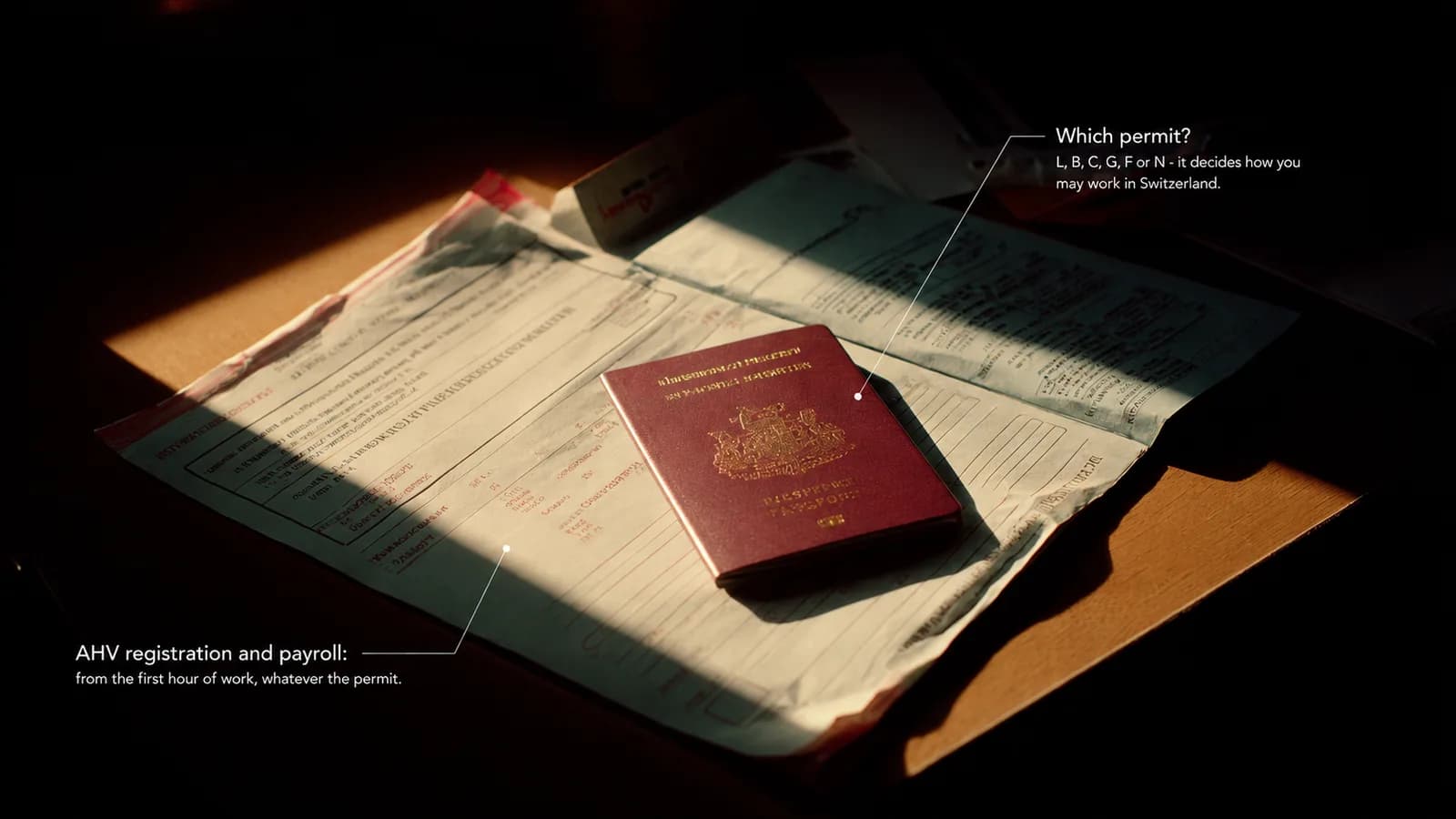
Permit B: residence permit
Valid for 5 years (EU/EFTA) or 1 year (other countries, renewable). Full right to work. The most common permit for long-term household staff.
Permit C: settlement permit
Permanent permit after 5-10 years of residence. Full right to work, no restrictions.
Permit L: short-term residence permit
Valid for up to 1 year, for temporary jobs. The right to work is tied to the registered employer.
Permit G: cross-border commuter permit
For people who live abroad and commute daily or weekly. Full right to work: EU/EFTA citizens anywhere in Switzerland, third-country nationals only in the border zone. Relevant in border cantons.
Permit F: provisional admission
Access to the labour market without quotas since 2019. The employer notifies the canton and pays the usual local wages and conditions.
Permit N: asylum seekers
Work is allowed once she no longer lives in a federal asylum centre (Art. 43 AsylG), and only with a cantonal work permit. The employer applies; Swiss and EU candidates still come first.
Permit S: people in need of protection
Temporary protection status (the war in Ukraine, for example). Working is allowed from the moment protection is granted; the employer reports the start of the job to the canton. The employer must observe the customary wage and working conditions.
If your household help lives just across the border and commutes daily, a dedicated process applies: register a cross-border worker.
Does the permit decide the procedure?
Almost never. Below the two limits the simplified procedure is open whatever her permit, with three exceptions: cross-border commuters who return every day to Liechtenstein, or to France while working in Bern, Basel-Landschaft, Basel-Stadt, Jura, Neuchâtel, Solothurn, Vaud or Valais; your spouse, registered partner and children; and a company as the employer (AG, GmbH, cooperative).
Simplified or ordinary: the four-question check →
Source: BGSA Art. 2 para. 2; WBB (BSV 318.102.04, as of 1.1.2026), no. 2105.
Notification duty: the 3-month rule for EU/EFTA
EU/EFTA citizens taking up a job in Switzerland for at most three months per calendar year do not need a residence permit. Instead, the notification duty applies:
1. Notify online before work starts
Use the cantonal portal, at the latest the day before work begins.
2. Check social insurance obligations
Even for short jobs, social insurance applies: old-age insurance (AHV), unemployment insurance (ALV) and accident insurance (UVG).
3. Observe the 3-month limit
All jobs in the calendar year add up. Beyond three months she needs a permit (L or B).
Employ your household help properly
Clino works out which social insurance applies, creates the payslips and prepares every registration, for CHF 19.90/month.
Get started →30 days free. Cancel anytime.
What must you check as an employer?
Before she starts, you are legally required to check her residence status and right to work. Your checklist:
Clino prepares the administrative part: payslips, social insurance and employment contract. More in our guide: Register a cleaner in 5 steps.
Cleaning & Household
The classic: rights, safety and pro techniques for cleaners.
- ~40 min
- in your language
- PDF certificate with QR code
Penalties
Employing someone without a valid work permit is a criminal offence. The Foreign Nationals and Integration Act (FNIA) sets heavy penalties:
Fines, monetary penalties and imprisonment
Anyone who deliberately employs a person without a valid permit risks imprisonment up to one year or a monetary penalty, up to 3 years in serious cases or on a repeat offence within 5 years (Art. 117 FNIA). Negligent violations: fines up to CHF 20,000.
Imprisonment up to 3 years
In serious cases or on a repeat offence within 5 years of a conviction, imprisonment of up to three years or a monetary penalty may be imposed (Art. 117 para. 1-2 FNIA).
Back payment of social insurance
All social insurance contributions must be paid retroactively, including default interest.
Register of undeclared work
The employer may be listed in the canton's register of undeclared work.
The safe way: check the permit before you hire, and register her correctly. Clino helps you with the second part.
Start in your canton
All details on compensation office, contributions and registration.


Frequently asked questions
Can an asylum seeker work as a cleaner?
Yes, once she no longer lives in a federal asylum centre, and with a cantonal work permit. You must pay the usual wages and working conditions.
What if my cleaner has no residence permit?
Employment without a permit is illegal. You face a fine of up to CHF 20'000 (for negligence), a monetary penalty or up to 3 years in prison if intentional, plus back payments of social insurance contributions. Details in our article Undeclared work: risks and fines.
Already living in Switzerland and working for you? AHV registration is still mandatory and possible, and the compensation office reports nothing to the migration office: registering a sans-papiers household worker.
Does an EU citizen need a permit?
For a job of up to three months per calendar year, a notification is enough. Beyond that she needs a B or L permit. Free movement guarantees access to the labour market.
Can I hire someone with a permit F?
Yes. Provisionally admitted people can work freely since 2019. Notify the canton and keep to the usual conditions.
How do I check residence status?
Ask for a copy of the permit and check the type and expiry date. Clino then helps with correct registration.
How much does Clino cost?
Clino costs CHF 19.90 per month. That covers the payslip, the social insurance declarations and the employment contract. Details on our pricing page.
In short: check, notify, employ correctly
Checking the work permit is a legal duty, and it protects you from heavy penalties. The rules depend on where she comes from, but the principle is simple: check the permit before you hire.
Clino takes the paperwork off your hands:
- ✓ Payslips with all social insurance contributions
- ✓ Legally compliant employment contract
- ✓ Accident insurance (UVG): application prepared
- ✓ Withholding tax calculation if needed
- ✓ All for CHF 19.90/month
Looking for your canton's guide?
Register household help: All 26 cantons at a glanceSources
- 1State Secretariat for Migration (SEM): Permit Types. www.sem.admin.ch/sem/en/home/themen/aufenthalt/eu_efta.html
- 2Federal Act on Foreign Nationals and Integration (FNIA). www.fedlex.admin.ch/eli/cc/2007/758/en
- 3SEM: Notification procedure for short-term employment. www.sem.admin.ch/sem/en/home/themen/fza_schweiz-eu-efta/meldeverfahren.html
- 4SEM: Employment for provisionally admitted persons. www.sem.admin.ch/sem/en/home/themen/arbeit/erwerbstaetige_asylbereich.html
- 5FSIO: Social insurance for domestic employees. www.bsv.admin.ch/de/beitraege-im-ueberblick
Disclaimer: This article is general information, not legal advice. For questions about a specific residence status, contact the cantonal migration office.
As of: April 2026. Information without guarantee.