Your Rights as a Cleaner in Switzerland
Do you work as a cleaner or domestic helper in Switzerland? Then you have clear, legally protected rights. Whether you work 3 or 30 hours a week, whether you hold a Swiss passport or not. This guide is your reference: bookmark it and show it to your employer if needed.
As a domestic worker in Switzerland you have the same basic rights as any employee - even without a written contract and even if you are paid in cash: the NAV minimum wage, at least 4 weeks of paid holiday, continued pay when you are ill, maternity protection and fixed notice periods. Registering you with the AHV is your employer's duty, not optional.
This applies when
For domestic helpers, cleaners, nannies and carers employed by a private household in Switzerland.
Official sources
Clino is not a job agency
We don't post jobs, hire anyone or arrange visas. This guide shows you the right path, pick your situation:
Know your rights
Three answers, and you see what the law guarantees you. Compare it with what your employer actually gives you.
Paid holiday
4 weeks per year + 8.33% holiday supplement (on an hourly wage)
Notice period
2 months
Pay when sick
2 months full pay
Accident insurance
Only occupational accidents covered. Below 8 hrs/week you are not insured by the employer in your free time, check your private cover.
Minimum wage
At least CHF 20.35/h (NAV domestic work, unskilled). Higher in some cantons such as Geneva.
Guideline values under federal law and the NAV for domestic work (continued pay per the Bern scale; the Zurich/Basel scales may differ). Your contract or a collective agreement may set better terms, never worse.
Your Employment Contract
You have the right to a written employment contract. Although Swiss law technically considers oral contracts valid (CO Art. 320), only a written contract truly protects you. Without one, you can hardly prove anything in a dispute.
What must be in the contract:
Salary and payment date
Gross hourly or monthly wage, payment date, holiday supplement shown separately.
Working hours
Days of the week, number of hours, overtime arrangements if applicable.
Tasks
What work you do (cleaning, ironing, cooking, childcare, etc.).
Notice period
Legal minimum: 1 month in the 1st year of service, 2 months from the 2nd year (CO Art. 335c).
Holidays
At least 4 weeks per year (5 weeks if under 20). For hourly pay: holiday supplement of 8.33%.
No contract?
Use our free employment contract template to make sure everything is covered.
For your rights to apply, your employer must register you properly. How registration works.
How to ask for a contract and registration
Weber
online
Hello Mrs Weber, I really enjoy working for you. It matters to me that everything is properly arranged: could we put together a short written contract and register the job with the OASI? That way we're both protected.
12:15Hello Maria, that's a good point. Yes, happy to, I'll take care of it.
12:40I'm so glad, thank you very much!
12:42Your Pay
Switzerland has no general statutory minimum wage. However, the NAV Hauswirtschaft (standard employment contract for domestic work) prescribes minimum wages for household employees. These apply in most cantons:
NAV minimum wages 2026
| Unskilled | CHF 20.35/h |
| Unskilled with at least 4 years of experience | CHF 22.30/h |
| Skilled with EBA (2-year apprenticeship) | CHF 22.30/h |
| Skilled with EFZ (3-year apprenticeship) | CHF 24.55/h |
Gross per hour, excluding supplements for holidays and public holidays (Art. 5 NAV domestic work, as of 1 January 2026).
Important: the NAV minimum wage applies from an average of 5 hours per week with the same employer (Art. 2 NAV). Your other rights - contract, OASI, holidays, accident insurance - apply regardless of your workload.
Some cantons also have a cantonal minimum wage of their own. What counts is always the highest figure that is applicable to you - and that is not everywhere the cantonal one.
Cantonal minimum wages 2026
| Geneva (GE) | CHF 24.59/h |
| Neuchâtel (NE) | CHF 21.35/h |
| Basel-Stadt (BS) | CHF 22.20/h |
| Jura (JU) | CHF 21.40/h |
| Ticino (TI) - own minimum wage CHF 20.00/h, but the higher NAV applies to you | CHF 20.35/h |
Important: Your payslip must show the holiday supplement of 8.33% (for 4 weeks holiday) separately. This supplement is not a bonus, it pays for your holiday days; you still have to take them off. Check your payslip!
If your employer pays you less than the minimum wage, you can claim the difference retroactively for up to 5 years.
Good to know:
Details for all 26 cantons in our Minimum wage guide.
Find all the details about the standard employment contract (NAV) in our dedicated guide.
Your Holidays
You are entitled to paid holidays. This is not negotiable but law (CO Art. 329a):
4 weeks per year
At least 20 working days on a 5-day week. This is the legal minimum for all employees aged 20 and over.
5 weeks under age 20
Until your 20th birthday you are entitled to 25 working days.
Holiday supplement for hourly pay
If your assignments are irregular, the holiday supplement is added to gross pay: 8.33% for 4 weeks, 10.64% for 5 weeks. With a fixed workload your wage simply continues during the holidays.
Watch out:
Holidays may not simply be replaced by money (CO Art. 329d para. 2). That is only permitted when the employment ends. If your employer tells you they would rather pay out the holidays instead of giving you time off, that is illegal.
Calculate your exact entitlement with our vacation calculator.
When You Get Sick
If you are sick and unable to work, you are entitled to continued pay (CO Art. 324a). How long depends on your years of service:
Continued pay by years of service
Bern scaleFull wage: for this long, depending on completed years of service.
Indicative values based on the Bern scale. The Zurich and Basel scales may differ.
From the 3rd day of illness, your employer can require a medical certificate. Some contracts require it from day 1. Check your contract.
If your employer has taken out daily sickness benefit insurance (KTG), you typically receive 80% of your salary for up to 720 days. This is a major advantage for you.
Tip:
Explained in detail: What to do when your cleaner is sick
How long your employer must keep paying your wage when you are ill is explained here: Continued pay when sick.
Pregnancy & Maternity
As a pregnant employee, you are especially protected:
14 weeks maternity leave
After birth you are entitled to 14 weeks of maternity leave at 80% of your salary (Income Replacement Act, EO). Requirement: you were AHV-insured in the 9 months before birth and worked at least 5 months during that period.
Protection against dismissal
During pregnancy and up to 16 weeks after birth, you cannot be dismissed (CO Art. 336c para. 1 lit. c). A dismissal during this time is void, meaning legally invalid.
No heavy lifting
From the 6th month of pregnancy you should not regularly lift more than 5 kg. Your employer must assign lighter tasks or release you with pay (maternity-protection standard; duty of care, Art. 328 CO).
Breastfeeding time
In the first year of the child's life, breastfeeding time counts as working time. Your employer must provide the necessary time and a suitable space.
Important:
More on your rights and continued pay during pregnancy: Pregnant as a cleaner and maternity benefit.
Accident Insurance (UVG)
Your employer is legally required to insure you against occupational accidents (UVG). This applies from the very first working hour:
Occupational accident (BU)
Always insured from hour 1. Premium paid by the employer. Covers accidents at work and on the commute.
Non-occupational accident (NBU)
From 8 hours per week with the same employer. Premium is deducted from your pay (approx. 1.4%). Covers accidents during leisure time.
What to do in case of an accident?
Report
Report the accident to your employer immediately.
Doctor
See a doctor and state that it is a work accident.
Insurance
Your employer reports the accident to the accident insurer (Suva or private insurer).
Benefits
You receive 80% of your salary as daily benefits from the 3rd day.
Not insured?
How the mandatory accident insurance (UVG) works for domestic workers: UVG accident insurance for domestic workers.
What it costs your employer, to forward: Insuring a cleaner: duties and costs for the household.
Termination
Both you and your employer can terminate the employment. Statutory notice periods apply (CO Art. 335c):
| Probation period (1st month) | 7 days |
| 1st year of service | 1 month (end of month) |
| 2nd--9th year of service | 2 months (end of month) |
| From 10th year of service | 3 months (end of month) |
During certain periods you cannot be dismissed (blocking periods, CO Art. 336c):
- During illness or accident (30 days in 1st year, 90 days from 2nd year, 180 days from 6th year)
- During pregnancy and 16 weeks after birth
- During mandatory military, civil or civil protection service (plus 4 weeks before and after for service over 11 days)
A dismissal during a blocking period is void. If notice was given before a blocking period, the notice period is suspended and continues after the blocking period ends.
Tip:
Calculate your personal notice period with the notice period calculator.
What Often Happens
- •Verbal agreement with no proof
- •Any hourly rate, often below minimum
- •Holiday supplement allegedly included in pay
- •No insurance, employer saves on premiums
- •No pay when sick, immediate replacement
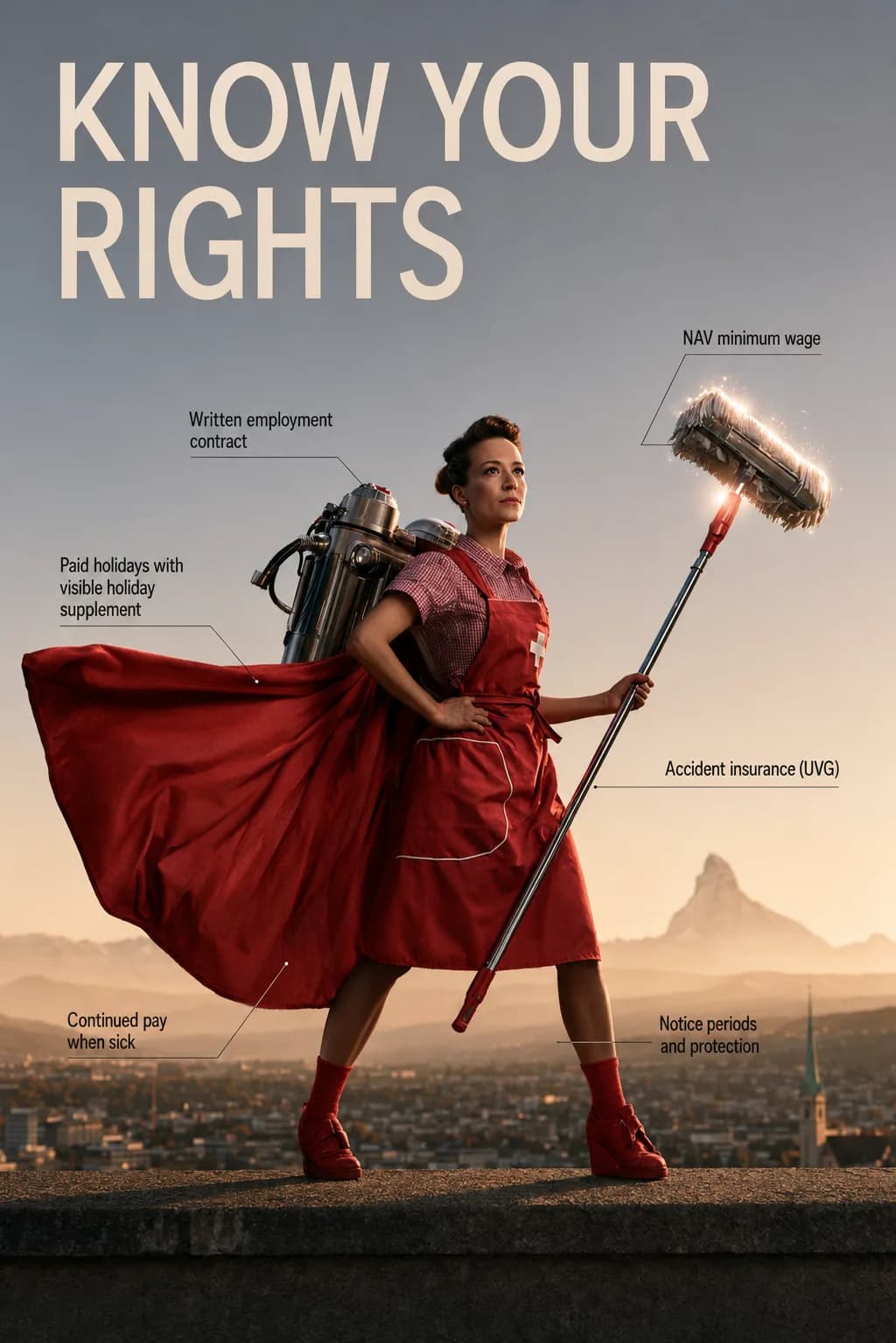
Your Rights (Law)
- •Written employment contract
- •NAV minimum wage from CHF 20.35/h
- •Holiday supplement 8.33% shown separately
- •Accident insurance from hour 1
- •Continued pay when sick
What to Do If Your Employer Refuses?
Not all employers follow the rules: too little pay, no registration, no contract - or your pay never arrives. Here is your action plan:
Step 1: Have a conversation
Raise the issue directly. Many employers do not know their obligations. Show them this article or the relevant legal basis.
Step 2: Refer to the law
Name specifics: NAV Hauswirtschaft (minimum wage), CO Art. 329a (holidays), CO Art. 324a (sick pay), UVG (accident insurance). This signals you know your rights.
Step 3: Contact the labour inspectorate
Every canton has a labour inspectorate that accepts complaints. The report is confidential and you are protected against retaliatory dismissal (CO Art. 336 para. 1 lit. d).
Step 4: Involve a trade union
Unions like VPOD or Unia offer free legal advice for domestic workers. They can also assist in negotiations.
You have rights, whether you work 3 or 30 hours a week, whether you hold a Swiss passport or not.
Learn more about the risks of undeclared work for employers and employees in our article Undeclared work: risks and penalties.
Your employer doesn't pay your wage, or only part of it? Here, step by step, is how to get your money: Wage not paid: what to do.
Your employer claims you're self-employed and don't need a contract? Beware: anyone who regularly works in the same household is almost always classified as an employee. All about bogus self-employment →
Check Your Work Situation
Frequently Asked Questions
Do I still have rights as a cleaner without a residence permit?
Yes. Employment rights (contract, pay, holidays, accident insurance) apply regardless of residence status. However, working without a permit can result in fines or deportation. Registration through your employer is therefore in both parties' interest.
What can I do if my employer does not issue payslips?
You are entitled to a monthly payslip. Request it in writing. If your employer refuses, report it to the labour inspectorate. Without payslips you also cannot declare your taxes correctly.
My employer pays me entirely off the books. Am I also liable?
The employer is responsible for registration. However, you are obliged to declare your income on your tax return. If you fail to do so, you are guilty of tax evasion. You also lose AHV contributions, accident coverage and unemployment insurance.
How many holidays am I entitled to when working part-time at 60%?
The same as full-time: at least 4 weeks (or 5 weeks under 20). For part-time work, holiday days are calculated proportionally. At 60% on a 5-day week, that is 12 holiday days per year (60% of 20 days).
Can my employer fire me from one day to the next?
No. Except during probation (7-day notice), statutory notice periods apply. Immediate dismissal is only possible for serious cause (e.g. theft). If dismissed without cause, you are entitled to damages (CO Art. 337c).
I only work 3-4 hours a week - what applies to me?
Almost everything in this article applies to you too: a written contract, OASI registration, the holiday supplement, accident insurance and protection against dismissal do not depend on your hours. Only the NAV minimum wage applies from an average of 5 hours per week with the same employer (Art. 2 NAV). Below that, pay is a matter of negotiation - still use the NAV rates as your benchmark.
Sources & further information
- 1Code of Obligations (CO) Art. 319-362 - Employment contract law - fedlex.admin.ch
- 2CO Art. 324a - Continued payment of wages during illness - fedlex.admin.ch
- 3CO Art. 329a-d - Holiday entitlement - fedlex.admin.ch
- 4CO Art. 336 - Protection against dismissal & protection periods - fedlex.admin.ch
- 5Standard employment contract for domestic workers (SR 221.215.329.4) - fedlex.admin.ch
- 6SECO - Employment law - seco.admin.ch
Build your professional CV
Swiss families expect a clean, bilingual CV. With our builder you get a professional PDF in 3 minutes — ready to send or print.
- Available in German, French, Italian, English or Spanish
- Optimized for Swiss households — permit, canton, services
- Your draft is auto-saved — pick up anytime
Cleaning & Household
The classic: rights, safety and pro techniques for cleaners.
- ~40 min
- in your language
- PDF certificate with QR code
Tell Your Employer
You have rights, and your employer has obligations. Clino makes it simple for both sides: automatic employment contract, correct payslips, all social insurances, and you receive a clean payslip every month.
CHF 19.90/month. 30 days free trial. Cancel anytime.
Get employed legally, without the awkward conversation
We prepare your personal employment pack and send it to your employer in their language. Free.
+ CHF 50 for you when they register you
Create your pack (2 min)Working without a contract?
We help you for free to understand your work situation and get things sorted. Write to us or leave your details. We'll get back to you personally.
One quick thing: where are you right now?
Disclaimer: This article is for general information and does not replace legal advice. Information is current as of July 2026. For specific legal questions, contact a trade union, legal advice service, or the cantonal labour inspectorate.
Last updated: 2 September 2026
Checked against official sources: Fedlex (CO, NAV domestic work, UVG) and SECO. Last review: July 2026.
