Multiple Employers
A Cleaner With Several Employers: Who Registers What for Social Security?

Your cleaner comes to you for 4 hours a week. After that she works another 5 hours for the household next door. Two completely independent employment relationships, no flatshare, no joint hire. The good news: almost every threshold in Swiss social insurance is checked per employer, not added up across her jobs. That goes for accident insurance, the wage ceiling and the pension fund. Here are the direct answers before we get into the detail.
The direct answers
Your cleaner also works elsewhere? The principle first, then the detail below.
Does the 8-hour threshold for accident insurance count per employer or combined?
Per employerNo, per employer. What counts is the weekly hours at each individual household, not the sum across all her jobs. If she works 4 hrs for you and 5 hrs for the household next door, non-occupational accident insurance (NBU) only becomes mandatory at the neighbour's.
Does the CHF 22,680 simplified-procedure wage ceiling apply per employer or to her total income?
Per employerPer employer. Each household can pay her up to CHF 22,680 a year under the simplified procedure, regardless of what she earns elsewhere. Only if ONE single employment relationship exceeds that ceiling does that one employer need to switch to the ordinary procedure.
Do I, as one of several employers, need to arrange a pension fund (BVG)?
Per employer, with opt-inUsually not. The BVG entry threshold is also CHF 22,680 a year, and it's checked per employment relationship. Since virtually every small household stays below it, no single employer triggers a BVG obligation, even if her combined income across jobs is higher. She can, however, voluntarily ask one of her employers to insure her total income (Art. 46 BVG). That's her decision, not your obligation.
Do all the households need to register jointly or separately with social security (AHV)?
SeparateSeparately. Each household is an independent employer and registers on its own with its own compensation office, even if they end up using different offices. There's no joint registration, and AHV contributions have no wage ceiling that would require coordination.
How does source tax (Quellensteuer) work when several employers pay wages?
Usually a flat 5%Under the simplified procedure, each employer withholds a flat 5% of what THEY pay. Her other jobs make no difference. Only under the rarer ordinary procedure does the relevant employer need to calculate the rate based on her overall employment degree. Details in the linked article.
Who is liable if she has an accident at your home? And on her day off?
Watch for a coverage gapIf the accident happens while she's working for you, it's an occupational accident. Your accident insurer pays, regardless of weekly hours (occupational accident cover is mandatory from the first hour). If it happens during her free time and none of her employers individually reach the 8-hour NBU threshold, no NBU applies. Her own health insurer (KVG) then has to cover it.
No. The thresholds for accident insurance, the wage ceiling and the pension fund don't add up. Each household is an independent employment relationship judged on its own. What your cleaner earns or works elsewhere has no bearing on your own registration. There is one exception: the voluntary BVG option she herself can request.
- UVG/NBU, the wage ceiling and the BVG threshold all apply per employment relationship. Combined hours or wages don't matter.
- AHV registration and source tax (under the simplified procedure) run independently at each household.
- The one exception: your cleaner can voluntarily request pension coverage for her total combined income (Art. 46 BVG).
This applies when
For households whose cleaner, nanny or caregiver also works for other, independent households. Not a flatshare, but several separate employments.
Official sources
Why each employment relationship is judged on its own
Unlike a flatshare sharing a single cleaner, there's no question of joint employership here at all: each household employs the same person under its own, fully independent employment relationship. No mechanism in Swiss social insurance law adds these relationships together. Every compensation office, every accident insurer and every pension fund only looks at the relationship it's responsible for.
The difference from a cleaner shared by several flatmates in the same home is fundamental: there it's ONE employment relationship with several beneficiaries. Here it's SEVERAL, fully independent employment relationships. More in our article on sharing a cleaner in a flatshare.
For you, as one of several employers, that means concretely: you don't need to coordinate with the other households, fill in any joint forms, or even know what she earns elsewhere. You can register your own employment relationship in a few minutes, regardless of what the neighbours do.
Accident insurance: the 8-hour threshold applies per employer
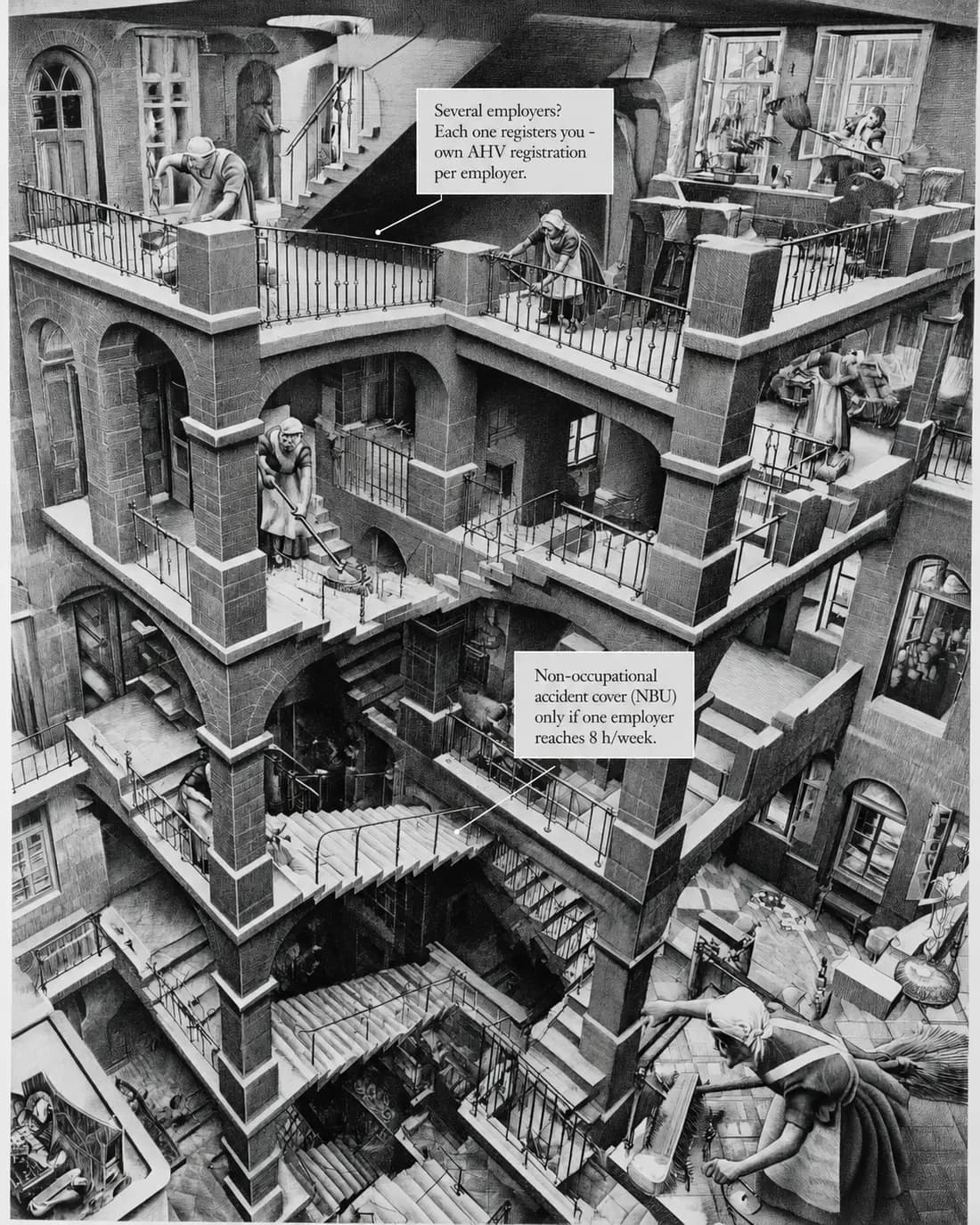
Under Art. 13 UVV, part-time employees are only covered for non-occupational accidents (NBU) if their weekly working time at ONE employer is at least eight hours. Small workloads at different employers aren't added together. If your cleaner works 4 hours for you and 5 hours for the household next door, she stays below the threshold with you even though her total working time is 9 hours.
Occupational accident insurance (BU) is independent of this: it's mandatory for every employment relationship from the very first hour of work, whether 2 or 20 hours a week. Only the additional cover for leisure-time accidents (NBU) depends on the 8-hour threshold at that one employer.
Try it yourself: per household, not combined
Enter the weekly hours for 2-4 households and see what applies to EACH employment relationship on its own.
Household 1
Household 2
Household 3
Combined (irrelevant)
This total has no bearing on any of the thresholds above. UVG, the wage ceiling and BVG are each checked strictly per individual employment relationship.
Assumption: CHF 30/hour, 4 weeks of vacation.
Next question: what does she cost your household per month, with AHV and accident insurance?
Calculate the cost for your household →Try the principle below with your own numbers. We cover premiums, reporting deadlines and coverage in full detail in our article on accident insurance for household employees.
The simplified-procedure wage ceiling: CHF 22,680 per employer
The AHV's simplified settlement procedure applies to wages up to CHF 22,680 a year AND per employer (as of 2026). This ceiling explicitly refers to the individual employment relationship, not to what your cleaner earns in total across all her jobs. If each of three households pays CHF 15,000 a year, every single one of them stays within the simplified procedure, even though her combined income is CHF 45,000.
If ONE single employment relationship exceeds the CHF 22,680 ceiling, say because you employ her several days a week, only THAT one employer needs to switch to the ordinary settlement procedure. The other households are unaffected and can keep using the simplified procedure.
Pension fund (BVG): why it almost never applies to small workloads
The BVG entry threshold sits at exactly the same level as the simplified-procedure ceiling: CHF 22,680 a year (2025/2026). That's no coincidence, since a wage that doesn't cross the one ceiling can't cross the other either. This threshold is also checked per employment relationship. So virtually every individual small household stays free of a BVG obligation, even when her combined income across several jobs is well above it. If your wage sits just below or just above the threshold, register your cleaner with a pension fund in advance: cancelling an affiliation retroactively is easy, registering after the fact can cost more. If she has already left the job, a voluntary affiliation is no longer possible and a forced affiliation follows (Stiftung Auffangeinrichtung BVG, written answer of 24 September 2026).
There is one exception, and it comes from your cleaner, not from you: under Art. 46 BVG she can voluntarily insure her total income from several small jobs. She does not need an employer's pension fund to agree: the Stiftung Auffangeinrichtung BVG runs a dedicated «Plan MA» (several employers). She registers herself, is invoiced herself, and collects the employer contributions from each household with a statement in which the other employers stay anonymous. For you that means: you only owe contributions from the moment she tells you about the plan (Stiftung Auffangeinrichtung BVG, written answer of 18 September 2026).
AHV registration and source tax: what each household handles separately
AHV is the simplest part: there's no wage ceiling above which several employers would need to coordinate. Each household registers independently with its own compensation office and pays contributions on what IT pays her. That's it. Even if two households happen to register with the same office, nothing changes: they remain two separate registrations. The only exception is when she already draws an AHV pension: the exempt amount then applies per employer, so at each household separately.
There is no lower limit either: in a private household, AHV contributions are due from the very first franc of wage. The small-wage exemption of CHF 2,500 a year that frees minor incomes from contributions in other sectors explicitly does not apply to domestic work. The only exception concerns young employees: up to and including the year your cleaner turns 25, wages of up to CHF 750 per year and employer stay contribution-free, unless she asks for them to be settled. This limit, too, counts per household, not across all her jobs.
Source tax is almost as simple, as long as everyone uses the simplified procedure: each employer withholds a flat 5% from their own wage payment, independent of her other jobs. It only gets more complex in the rarer case of the ordinary procedure. There, the relevant employer calculates the rate based on her overall employment degree. Above a gross income of CHF 120,000 a year, the mandatory subsequent ordinary assessment (NOV) is added on top. That threshold is practically never reached with small household jobs.
We cover tariffs, permit categories and the 2021 reform in full in our article on source tax for household employees.
Liability for an accident: who pays, and where a real gap can appear
If your cleaner has an accident while working at your home, that's an occupational accident. Only your accident insurer is responsible for it, regardless of weekly hours, because occupational accident cover is mandatory from the very first hour of work. It makes no difference whether she works 2 hours a week for you or 20: as long as you've registered her correctly, your insurer pays.
It's different for an accident during her free time, say on her day off. Here only non-occupational accident insurance (NBU) applies, and that only exists if at least ONE employer employs her for 8 or more hours a week. If none of her employers individually reach that threshold, a genuine NBU coverage gap appears. Her total hours across all jobs make no difference, however high they are.
In that case, her own mandatory health insurance (KVG) steps in and covers the accident costs, but with a deductible, co-payment and no daily allowance, unlike UVG. Important: some people deliberately exclude accident cover from their health insurance because they assume they're covered through an employer. Anyone with several small jobs who doesn't reach the 8-hour threshold at any of them should actively check with their health insurer that accident cover stays included.
What actually happens when no insurance applies is covered in our article on an accident of an uninsured cleaner.
Frequently asked questions
Do weekly hours across several employers add up for accident insurance?
What happens if I pay my cleaner more than CHF 22,680 a year, but she also works elsewhere?
Do I need to know how much my cleaner earns at other households?
Can my cleaner voluntarily request pension coverage for her combined income from several jobs?
How do I register my cleaner with AHV if she's already registered with another household?
We're neighbours and want to agree on who registers her. Is that necessary?
Who pays if she has an accident at my home, even though I only employ her 3 hours a week?
Does the flat 5% source tax apply separately at each employer?
Further reading
Legal notice: This article provides general information on how Swiss social insurance treats a domestic worker employed by several independent households. It does not replace legal or tax advice. For specific questions on voluntary BVG cover, source tax under the ordinary procedure, or cantonal specifics, consult your compensation office, pension fund or tax authority directly.