Safety
First-aid course for your nanny: which one to book and who pays

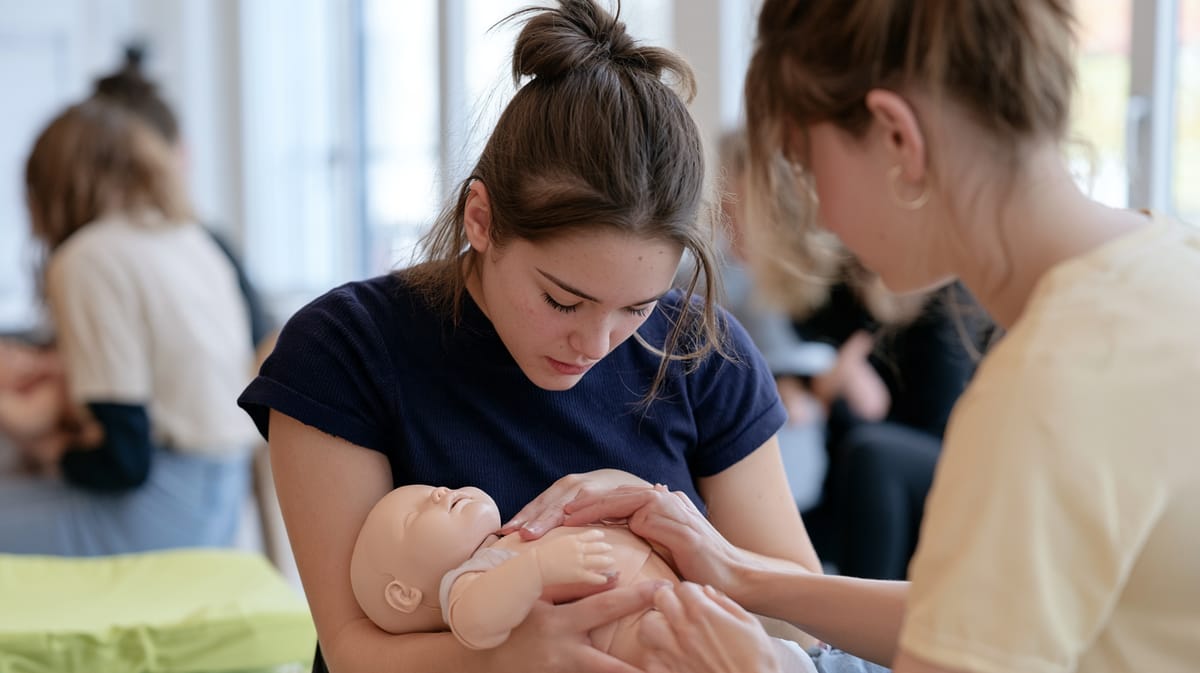
The honest answer: no course is legally required. But that isn't really your question. Your question is whether this person will know what to do when you are not there. Here is which course to book, who pays for it, and what to settle before the first shift without you.
Answer in 30 seconds
- ✓No legal obligation for nannies - but sensible, and you may require it in the employment contract.
- ✓The right course is BLS-AED-SRC Complete (3-4 h), not Compact (1-2 h). Certificate valid 2 years.
- ✓If you require the course, you pay for it - Art. 327a CO. A 50/50 agreement is then void.
- ✓Before the first shift alone: fill in the emergency card and put it on the fridge (generator below).
Is a first-aid course mandatory?
No. No federal law requires a nanny in a private household to hold a first-aid certificate. Unlike daycare centres and day families, which are licensed and supervised at cantonal level, employing a nanny in your own home is barely regulated. The duties that come with hiring a nanny concern registration and insurance, not training.
What does matter in practice:
- ●You may make the course a condition in the employment contract. Many families do, and it is the cleanest route, because it settles the cost question at the same time.
- ●Placement agencies and au-pair organisations often require proof themselves. That is their condition, not a legal one. Ask your agency or your cantonal migration office directly if a permit is involved.
- ●Licensed daycare centres and day families are subject to cantonal rules that differ from canton to canton. They do not apply to the nanny working in your home.
Which course is the right one?
This is where the most common mistake happens. "First aid" is not a protected term and courses differ enormously. Three types to keep apart:
BLS-AED-SRC Complete - this is the one you want
The Swiss standard under the Swiss Resuscitation Council (SRC) course guidelines, also called Generic Provider: 3-4 hours, resuscitation on adults AND children, defibrillator, choking on a foreign body, hands-on practice on a manikin. The certificate is valid for 2 years. For groups who look after children the content may be adapted - ask the provider about it.
BLS-AED-SRC Compact - not enough
The short version (Basic Provider), 1-2 hours. It covers the basics of resuscitation, but not at the depth someone needs when alone with your child. When booking, watch the word in the course title: Compact or Complete. They are not the same thing.
Child-emergency courses - the sensible addition
"Emergencies with small children" (Samaritans) or "First aid for babies and toddlers" (cantonal Red Cross organisations) cover what parents are actually most afraid of: choking, falls, burns, poisoning, febrile seizures, allergic reactions. Content and duration are set by each provider - there is no single national standard here.
💡 Don't confuse it with the driving-licence first-aid course
The Nothelferkurs required for a Swiss driving licence runs 10 hours, is valid for 6 years and is built around adults and road accidents. "I did the first-aid course for my licence" therefore does not answer the question about child emergencies.
Before you book - or accept a certificate: 5 questions
"I did a first-aid course once" tells you almost nothing on its own. These five points settle it in two minutes:
- 1What exactly is the course called? Does it say "Complete" or "Compact"? Does it say "SRC"?
- 2Was there practice on child and infant manikins - or only a theoretical discussion?
- 3What language was the course held in? SRC materials exist in German, French, Italian and English, but not every local course runs in every language. Ask before booking.
- 4When was the course? The BLS-AED-SRC certificate is valid for 2 years. Anything older needs refreshing.
- 5Which guidelines was it taught under? 2026 is a transition year: courses under the SRC 2021 guidelines are still permitted until 31.12.2026, after which the 2025 guidelines apply. Both are currently showing up in booking systems.
What does it cost - and where do you book?
There is no single national price. Courses are run by the cantonal Red Cross organisations, local Samaritan associations and private providers, and each of them sets its own duration and price. Three concrete examples, checked in August 2026:
| Provider | Duration | Price |
|---|---|---|
| Red Cross, canton of Bern | 7 h | CHF 180 |
| Samaritan associations (regional) | 3-6 h | CHF 120-190 |
| Various SRC course providers | 3-4 h | from approx. CHF 80 |
These figures are examples, not a price list. In another canton or with another association it looks different. Trust the price in the booking window, not a number from a blog post.
Independent support: Swiss Nanny Association
The Swiss Nanny Association is a nonprofit association supporting nannies and Au Pairs with information, resources, training and guidance on fair working conditions in Switzerland. It regularly runs first-aid and CPR courses and training days for nannies.
For information and resources, visit swissnanny.org ↗Who pays for the course? This is not a matter of taste
Many guides line up "the family pays", "50/50" and "the nanny pays" as three equivalent models. Legally that is off. One question decides it: did you order the course?
You require the course - you pay for it
Art. 327a para. 1 CO obliges you to reimburse all expenses necessarily incurred in performing the work. Continuing education counts as necessary in that sense when the employer orders it. That is exactly what you do by making the course a condition. And paragraph 3 is unambiguous: agreements under which the employee bears necessary expenses in whole or in part are void. A 50/50 clause for a course you require therefore does not hold.
She takes the course voluntarily - then you are free
If you require nothing and she wants to train on her own initiative, Art. 327a CO does not apply automatically. You are then free to agree whether and how you contribute. A contribution is a nice gesture - but a gesture, not a duty.
You require the certificate already at application stage - different case
"Requirement: valid child first-aid certificate" is a hiring prerequisite, not an ordered course. For a course someone attended at their own expense before the employment relationship began, no duty to reimburse can be derived from Art. 327a CO. Anyone who wants good applicants covers the refresher anyway.
On time: if you order the course, paying for the course time follows logically. It matches how ordered training is treated, and it is what a fair employer does regardless. But there is no statutory article declaring course time to be working time in general: the Labour Act and its working-time rules do not apply to private households at all (Art. 2 para. 1 lit. g ArG). What applies in the household instead is set by the cantonal standard employment contract. So put it in writing rather than relying on it being obvious.
How often to refresh?
The BLS-AED-SRC certificate is valid for 2 years. There is no separate, shorter "refresher" in the SRC system. You attend the same course again, and validity runs for another two years.
Set a reminder 21 months after the course date. Resuscitation is a motor skill: it fades quietly, without anyone noticing, until the day it matters.
What belongs in the employment contract
If you require the course, it belongs in writing in the nanny's employment contract, including who covers the cost, since you owe it anyway. Three wordings to copy:
She starts next week and the next course is in two months
That is the normal case, and it is no reason to postpone the start. Book the course - and do these four things before the first shift without you:
This handover takes barely an hour and removes more tension from both sides than any course on its own. The course makes her capable of acting; the briefing makes her capable of acting in your home. Registering her with the AHV belongs on the same list.
Emergency card for the fridge
Fill it in, print it, put it on the fridge. If you don't share a language: pick a second language and the card comes out of the printer bilingual, the same information twice, side by side.
Create the emergency card
Fill in, print, done. Runs entirely in your browser.
Preview
Emergency card
- Our address
- -
- Floor / doorbell
- -
- Child
- -
- Parents
- -
- Backup contact
- -
- Paediatrician
- -
- Allergies / important
- -
- Emergency medication
- -
- First-aid kit
- -
- Insurance card
- -
Child unresponsive or not breathing normally: call 144 immediately and follow the dispatcher's instructions.
The entries stay in this browser window. Nothing is stored, nothing is sent to us. Reload the page and the form is empty again.
Frequently asked questions
Is the driving-licence first-aid course enough?
What about the classic babysitting course?
My nanny has a foreign certificate - does it count?
Does Clino offer first-aid courses?
Sources
- Swiss Resuscitation Council - Course Guidelines 2025 (course types, duration, validity, transition period to 31.12.2026): resuscitation.ch
- Code of Obligations Art. 327a (expenses) and Art. 2 para. 1 lit. g Labour Act ArG (private households): fedlex.admin.ch
- Samaritans Switzerland - "BLS-AED-SRC Complete" and "Emergencies with small children": samariter.ch
- Tox Info Suisse - emergency number 145: toxinfo.ch
Course names and price examples checked in August 2026.