Daycare, Nanny or Childminder? The Honest Comparison for Swiss Parents
Choosing the right childcare is one of the most important decisions young families face. Daycare, nanny or childminder - each model has strengths and weaknesses. This guide compares all three options honestly: costs, flexibility, pros and cons. So you can find the best solution for your family.
Childcare Finder: Which model suits you?
Answer 4 short questions and get a personal recommendation.
How many children do you have?
A childminder is often the cheapest solution, daycare scores with socialisation and a structured routine, and a nanny pays off above all with two or more children or when you need maximum flexibility.
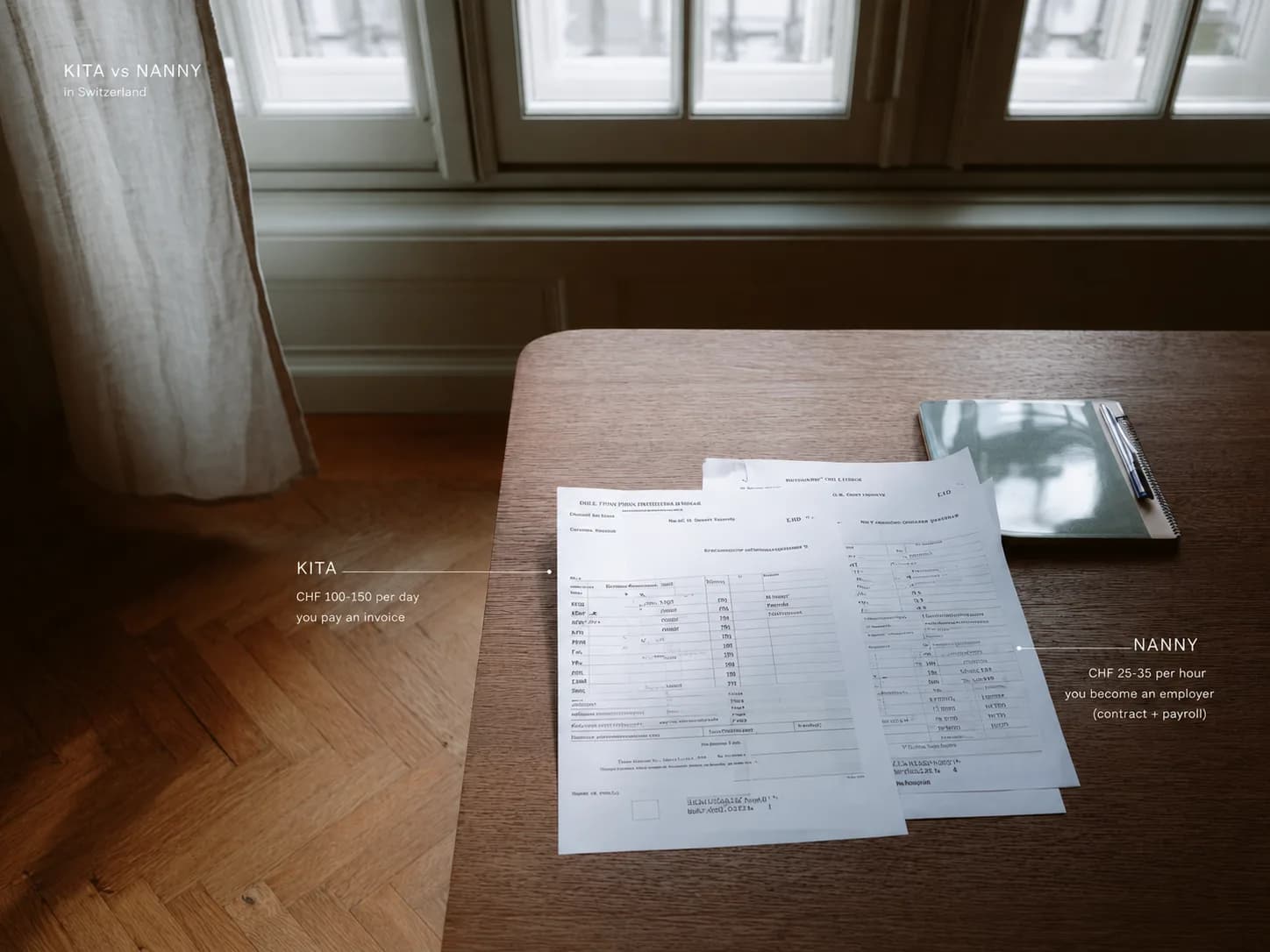
- Daycare: CHF 100-150 per day, socialisation, but 6-18 month waiting lists.
- Nanny: CHF 25-35/h, maximally flexible - employer obligations from day one.
- Childminder: CHF 6-12/h per child, family setting, often the cheapest option.
The Three Childcare Models at a Glance
Before we go into detail: here is a quick overview of the three most common childcare options in Switzerland.
Daycare (Kita)
Age: 3 months to 4 years
Cost: CHF 100-150 per day
Hours: Fixed opening times (approx. 7am-6pm)
Daycare centres offer professional group care. Children learn social skills, follow a structured routine and are supervised by trained professionals. The big drawback: waiting lists of 6 to 18 months are common, and you must stay home when your child is sick.
Nanny
Age: Any age
Cost: CHF 25-35 per hour
Hours: Freely negotiable
A nanny comes to your home and cares for your children individually. Maximum flexibility in terms of times and tasks - many nannies also handle light household duties. The price is higher, but your children receive full attention. Important: you become an employer with all obligations.
Childminder (Tagesmutter)
Age: 0 to 12 years
Cost: CHF 6-12 per hour per child
Hours: By arrangement, often more flexible than daycare
Childminders care for small groups (usually 2-5 children) in their own home. This offers a family atmosphere with personal care. Cost per child is lower than a nanny, and the age range often extends to primary school. Whether you become an employer depends on the arrangement.
When Do You Become an Employer?
This is the most important question many parents overlook. And the answer has financial and legal consequences.
Clear rule for nanny and au pair
And with a childminder?
This is where it gets complicated. If the childminder works exclusively for your family, she is your employee (AHV, accident insurance, employment contract). If she cares for children from multiple families through a childminder network, she is typically self-employed.
In practice, most childminders care for multiple families and are organised through placement agencies - so you are usually not the employer. But: if in doubt, clarify with the compensation office. If you are not sure which type of household help fits your situation, our short quiz can help.
As soon as you hire a nanny, AHV, accident insurance and employment contract apply - from day one.
Cost Comparison - Honest Numbers
The true costs of childcare surprise many parents. Here are the key figures at a glance:
Detailed childcare cost calculation
Free Checklist: Hire Household Help Correctly
AHV, accident insurance, contract. All on one page, by email in 30 seconds.
No spam. Unsubscribe anytime.
Frequently Asked Questions
What is cheaper: daycare or nanny?+
For a single child, daycare is almost always cheaper - especially with subsidies. From the second child, the calculation changes: a nanny costs the same regardless of whether she looks after 1 or 3 children. With 2+ children, a nanny can be cheaper than two daycare places.
From what age can my child attend daycare?+
Most daycare centres accept children from 3 months. Some have a minimum age of 4 or 6 months. Care usually ends when the child enters kindergarten (4-5 years).
Do I need to register my nanny with AHV?+
Yes, always - from the first franc. As soon as you employ a nanny, AHV registration is mandatory, regardless of the salary amount. Clino prepares the registration for you.
Is a childminder cheaper than a nanny?+
Generally yes. A childminder charges CHF 6-12 per hour per child, a nanny CHF 25-35 per hour (regardless of the number of children). For one child, the childminder is significantly cheaper. With 3+ children, the nanny can become cheaper per child.
Can I deduct childcare costs from my taxes?+
Yes, in all cantons. The maximum deduction varies by canton (between CHF 8,000 and CHF 27,300 per child per year; the federal deduction is CHF 25,800). Requirement: care is provided by a third party, and you have a receipt or payslip.
Ready for the right childcare?
If you choose a nanny or childminder, Clino makes your employer life easy: AHV registration, payroll, accident insurance and employment contract - all prepared step by step for CHF 19.90/month.
Start free nowRelated Articles
Sources & Legal References›
- BSV (bsv.admin.ch) - UKibeG, childcare policy
- kibesuisse (kibesuisse.ch) - Daycare standards
- AHV-IV (ahv-iv.ch/p/2.06.d) - Household worker contributions
- SECO (seco.admin.ch) - Employment law
- Tagesfamilien Schweiz (tagesfamilien.ch) - Childminder standards
What does which type of care cost you?
Set children and care days. The bars show the estimated monthly cost per option (guideline).
Per child and day, often subsidised by income. Guideline without subsidy.
Hourly wage is fixed, no matter how many children. Incl. social contributions (employer pays around 6.9% on top).
Care in the childminder's home, usually per child and hour, often via an association.
Employ a nanny privately? Then you are the employer: AHV from the first franc, registration within 30 days, payroll every month. Clino prepares registration, contract and payroll for you, for CHF 19.90 a month.
Register, nothing charged before day 30Rough guideline values for orientation (as of 2026), not binding prices. Real cost depends on canton, provider, subsidies and the agreed wage. Nanny: NAV minimum-wage level, around CHF 22.30/h plus employer contributions. First 30 days free, nothing charged before day 30.
