Retirement
What pension will you have if you work in private homes?


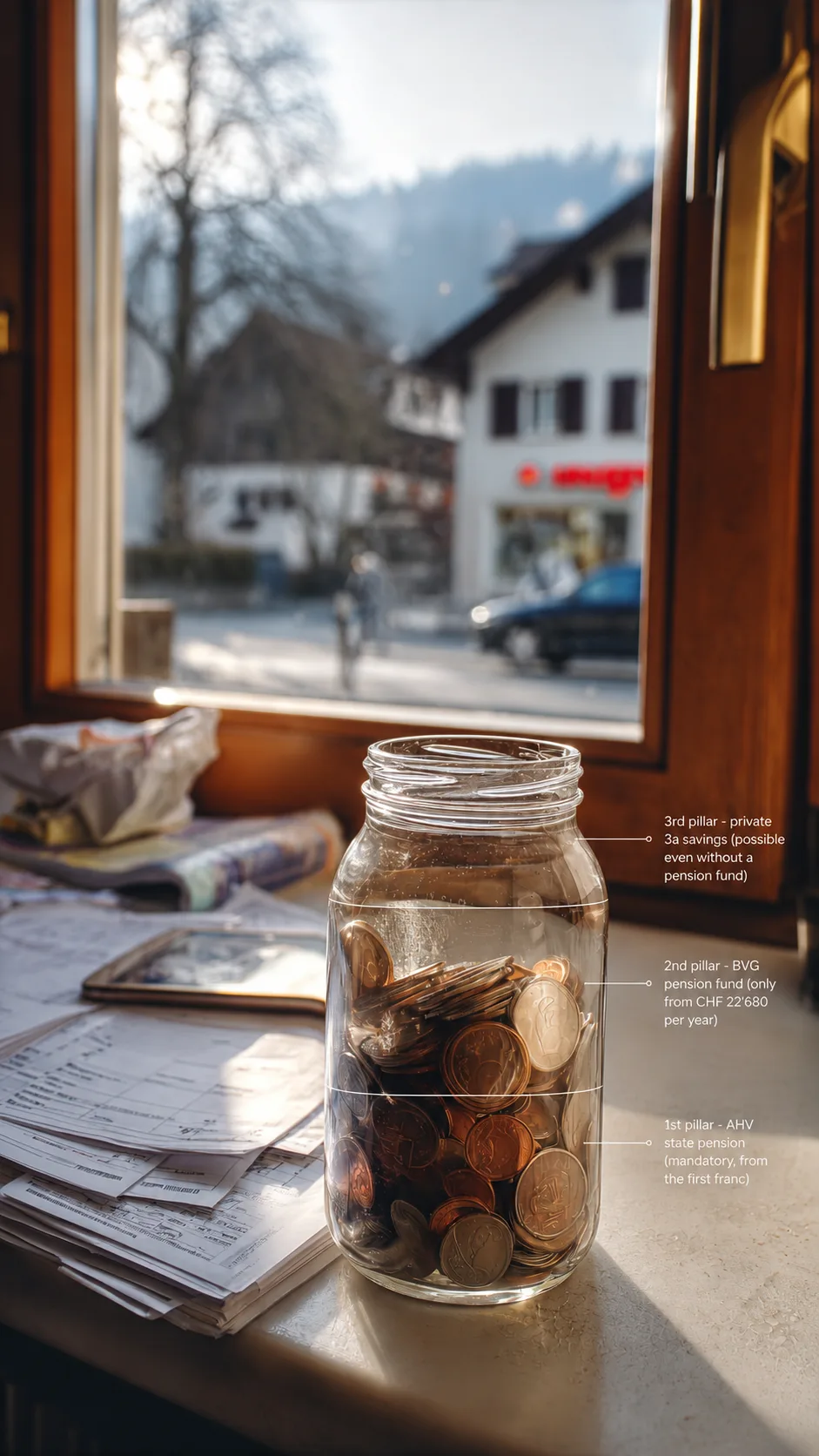
The AHV alone is rarely enough. And if you clean for several families, you often have no pension fund at all - without knowing it. Here is how to check your own position in ten minutes.
On a household wage the AHV pension usually lands near the minimum of CHF 1'260 a month, and anyone earning a little at each of several families frequently has no pension fund whatsoever. Both can be checked - and both can still be improved while you are working.
- A full AHV means 44 contribution years. Each missing year costs roughly one forty-fourth of the pension.
- The pension fund only starts at CHF 22'680 of annual salary - per employer, not in total.
- Without a pension fund you may pay 20 per cent of your wage into pillar 3a, up to CHF 36'288.
This applies when
You work in private households in Switzerland - as a cleaner, nanny or carer.
- AHV pension / month
- CHF 1'260 – CHF 2'520
- Contribution years for a full AHV
- 44
- Pension fund starts at, per employer
- CHF 22'680
- Pillar 3a without a pension fund
- CHF 36'288
What years without registration cost
CHF 212
less AHV pension, every month, for life
for 6 years without registration
You can still save CHF 177 of it: contributions for the last 5 years can be paid retroactively.
Compensation office
Individual account (IK) statement
AHV no.756.••••.••••.••
| Year | Months | Income CHF |
|---|---|---|
| 2017 and earlier | recorded without gaps | |
| 2018 | 01–12 | 28'800 |
| 2019 | 01–12 | 28'800 |
| 2020 | – | no entries |
| 2021 | – | can still be paid |
| 2022 | – | |
| 2023 | – | |
| 2024 | – | |
| 2025 | – | |
Contribution years38 of 44
Full pension at this wage: CHF 1'556 a month. Estimate with the same wage in all 44 years, without childcare credits.
First step: order your account statementThe one step that always pays off
Before calculating anything: order your individual account statement (IK-Auszug) from your compensation office. All you need is your AHV number from your health-insurance card. It is free, you may request it at any time, and it shows in black and white which contribution years and which wages the AHV has actually recorded for you. A great many gaps are simply wages that were never declared - and that can only be repaired once you know about it.
How to read your AHV account statement, and what to do about a gap.
If years are missing in which you did work, the wage was probably never settled, and you were working undeclared, often without knowing it. That is no reproach to you, but it is your pension. If AHV was deducted from your wage and never paid in, the year can still be entered if you can prove the deduction.
What the AHV alone delivers
The AHV pension rests on two things: how many contribution years you have and the average of your wages. With a full 44 years it lies between CHF 1'260 and CHF 2'520 a month. The minimum goes to those who earned little; the maximum only from an average income that a household wage barely reaches. Realistically, most household employees land in the lower third of that range.
One missing contribution year cuts the pension by about one forty-fourth - roughly 2 per cent. Four missing years are therefore already almost a tenth less, for life.
The gap almost nobody sees: years abroad
 3 yearsnot yet in Switzerland5 yearsundeclared work
Anyone who arrived in Switzerland at thirty or forty simply could not pay in for 44 years here. That is the most common reason for a reduced pension, and it affects nearly everyone who migrated. Contribution years in an EU or EFTA country are not lost - they are paid out separately from there, but they do not fill the Swiss gap. You end up with two smaller pensions rather than one large one. How the Swiss pension reaches you if you move back to your home country depends on the country.
Worth knowing: years between 18 and 20 count too. If you worked and contributed in Switzerland back then, those years can partly plug later gaps. So do years spent raising children - childcare credits raise your average income.
Why you probably have no pension fund
The second pillar has not been taken away from you - it simply starts at CHF 22'680 of annual salary, and that amount counts per employer. Someone earning CHF 8'000 at each of five families reaches CHF 40'000 and is still under the threshold at every single one. The result: no pension fund, even though total income is well above it.
What you can do about it
If your wages added together exceed CHF 22'680, you can insure yourself voluntarily with the Substitute Occupational Benefit Institution (Auffangeinrichtung BVG). It costs contributions, but it builds a second pillar where there was none. The other route is pillar 3a: without a pension fund you may pay in up to 20 per cent of your income, to a maximum of CHF 36'288 a year - many times the CHF 7'258 open to employees who have one. Together they are more achievable than they sound if you start early.
And if it still is not enough?
Then there are supplementary benefits (Ergänzungsleistungen). They are not charity but a legal entitlement: where the AHV pension and your assets do not cover recognised living costs, your canton of residence pays the difference. One condition among others is residence in Switzerland. So nobody who declared their work properly all their life ends up with nothing - but it is a tight living, which is exactly why every declared franc today matters.
Work through your own position
The pension planner takes your hourly rate, your hours, the number of employers and your contribution years so far, and shows what that turns into as AHV and pension fund - including whether you clear the pension-fund threshold at all.
Open the pension plannerCommon questions
I worked undeclared for years. Can I still make that up?
Partly. Unsettled contributions can usually only be paid retroactively for the last five years (seven after a criminal offence by the employer) - anything older is time-barred and permanently missing from your pension. That is exactly why proper registration is not paperwork, it is your retirement income. Talk to your compensation office before more years expire.
Do my years in Spain, Portugal or Italy count towards the Swiss pension?
They count towards entitlement, but not towards the size of the Swiss pension. Each country pays out the pension earned there. You have to claim it there too - most easily via the Swiss compensation office, which forwards the application. Apply in good time; it takes a while.
I only work a few hours. Is registering even worth it?
Yes, for two reasons. First, every settled year counts as a contribution year - even on a small wage - and prevents a gap. Second, as a registered employee you are properly insured against accidents and entitled to unemployment benefit if the job ends. The wage is one thing, the years are another.
Can I use pillar 3a on a small income?
Yes. There is no minimum - you can pay in what you can, even CHF 50 a month. The amount is deducted from taxable income, which saves little tax on a low income, but the money is yours and it grows. The key point: without a pension fund your ceiling is 20 per cent of your income, and missed years from 2025 onwards can only be made up to a limited extent.
Where the figures come from
AHV pension and contribution years
The minimum and maximum pension (CHF 1'260 / CHF 2'520 a month), the 44 contribution years of scale 44 and the reference age of 65 come from the federal pension ordinance for 2026 and live in the code at src/lib/pension.ts. The rule of thumb that one missing year costs a forty-fourth is an approximation: what governs is the pension scale, which cuts more sharply at very few contribution years.
Pension fund and pillar 3a
The BVG entry threshold of CHF 22'680 applies per employment relationship. The 2026 pillar 3a maximums are CHF 7'258 with and CHF 36'288 (at most 20 per cent of earned income) without a pension fund; both are unchanged from 2025.
Are you even registered properly?
Every year without a payroll declaration is a year less pension. Clino guides your employer step by step through registration with the compensation office and the monthly payslip.
Free Checklist: Hire Household Help Correctly
AHV, accident insurance, contract. All on one page, by email in 30 seconds.
No spam. Unsubscribe anytime.
Salvador Jovells, founder of Clino