Paying your cleaner in cash - is it legal?
The question comes up all the time: Can I pay my cleaner in cash? The short answer: Yes. But the question you should actually be asking is a very different one. In this article we bust the myth and show what really matters.
Yes, paying your cleaner in cash is perfectly legal in Switzerland, it only becomes undeclared work if she is not registered with the AHV.
- Registration is mandatory from the very first franc, for cash and bank transfer alike.
- Unregistered, the Ersatzkasse UVG pays after an accident - and charges you substitute premiums up to 5 years back.
- Paying cash and registering properly work together, done in four steps.
Is paying cash allowed?
Yes - paying cash is legal.
So what's the problem?
Not the cash - the missing registration.
When to register?
AHV-liable from the first franc.
And if undeclared?
Back-pay + fines loom.
The short answer: Yes, cash payment is legal
Swiss francs are legal tender (Art. 3 WZG). Anyone can pay their cleaner in cash - by bank transfer, Twint or indeed in cash. The payment method is irrelevant under employment law.
Art. 323b CO even states that wages must be paid in legal currency. Cash is not only permitted but explicitly provided for by law.
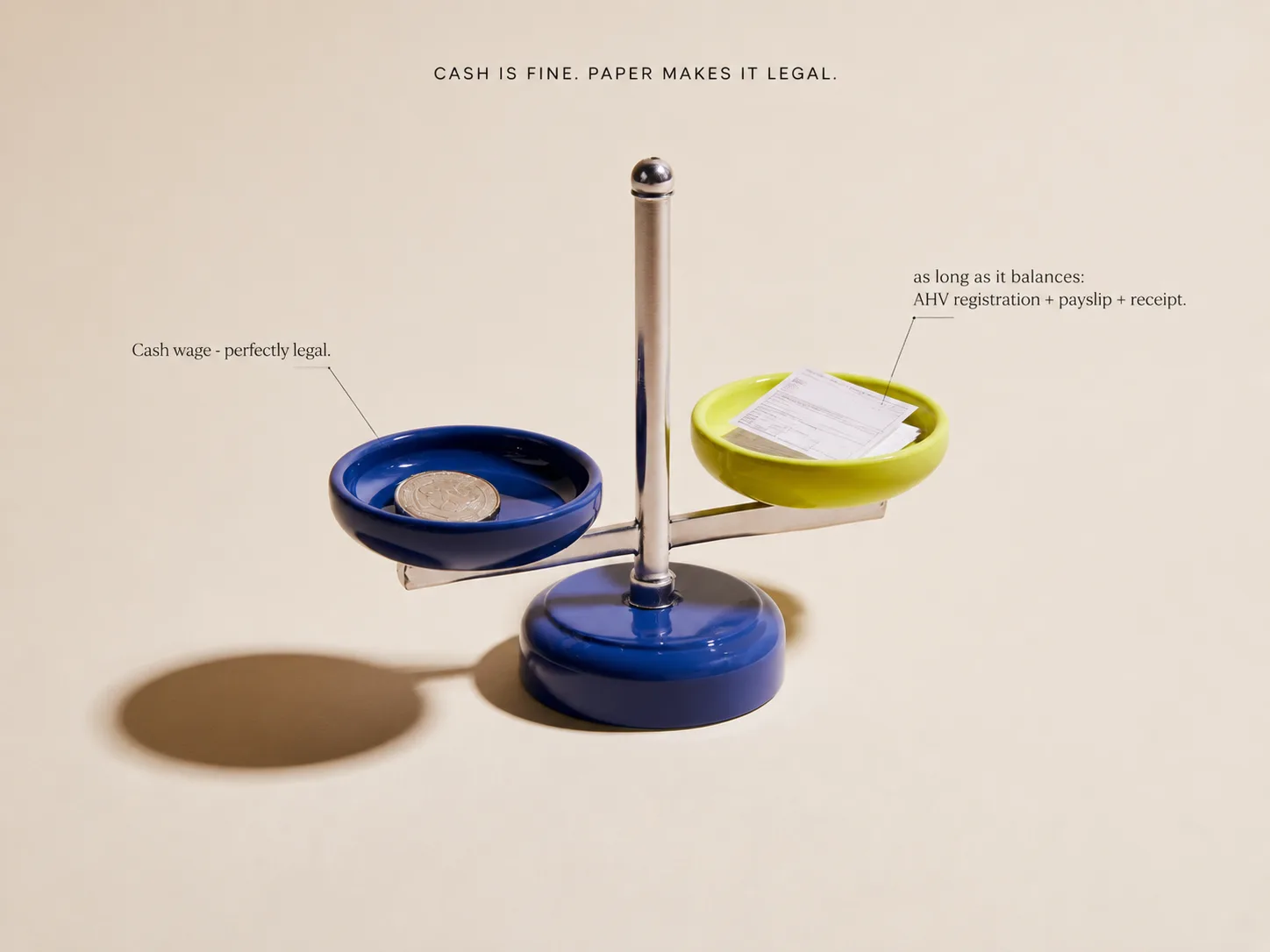
Paying in cash is legal. Not registering is not.
The real problem: Not the cash, but the missing registration
When people ask 'Can I pay my cleaner in cash?', they usually mean: 'Can I pay my cleaner without registering her?' And that's exactly the problem.
The Federal Act on Measures to Combat Undeclared Work (FMIA) does not define undeclared work by payment method. Undeclared work occurs when the employment is not registered with social insurance (OASI) - regardless of whether payment is in cash or by bank transfer.
In other words: you can pay your cleaner by bank transfer and still be committing undeclared work - if the registration is missing. Conversely, cash payment is perfectly legal as long as the registration is in order.
Common misconception
More on undeclared work in our detailed article: Undeclared Work in Switzerland: Risks, Penalties and Alternatives.
When do I need to register my cleaner?
This is often misunderstood: in a private household there is no minor-amount threshold. AHV registration applies from the very first franc of wages - regardless of workload. The only exception: employees under 25 whose annual wage is below CHF 750. A few examples:
Only exception: employees under 25 earning under CHF 750/year
Bottom line: practically every regular cleaning help in a household must be registered. Paying cash makes no difference - exactly the same rules apply as for a bank transfer.
Quick check: do you have to register your cleaner?Our detailed guide shows you step by step how registration works: Register your cleaner in Switzerland.
Risks without registration - even with cash payment
Whether cash or bank transfer: without registration you as the employer bear significant risks.
Don't underestimate accident risk
Cash WITHOUT registration
- •Undeclared work under FMIA
- •No accident insurance - substitute premiums (Art. 95 UVG)
- •OASI back-payment up to 5 years retroactively
- •Tax penalties up to 300% surcharge
Cash WITH registration
- •Employed by the book
- •AIA accident insurance for your cleaner
- •OASI contributions correctly paid
- •Costs tax-deductible
Properly registered, your cleaner also has all her statutory rights - from continued pay during illness to paid holidays and protection against dismissal. For an overview, see the rights of a household helper.
Pay cash AND register properly - here's how
Cash payment and legal employment are not mutually exclusive. Four steps and you're done:
Register with the OASI compensation office
Register as a private employer with the cantonal compensation office. It takes about 15 minutes and can often be done online.
Create an employment contract
Put wages, working hours, holidays and notice period in writing. Clino creates the contract automatically for you.
Deduct social contributions from cash wages
Deduct the employee share (OASI/DI/EO/UI approx. 6.4%) from the agreed gross wage and pay the net amount in cash. You remit the employer share quarterly.
Issue receipt & create salary statement
Have every cash payment receipted. At year-end create a salary statement - Clino generates this automatically.
Cash or app: behind every payment there is a payslip, and the amount paid out must match it. The receipt or the payment confirmation only proves that the money changed hands.
Original for the employer, carbon copy for the cleaner.
e.g. TWINT or bank transfer, with the purpose in the message.
Clino prepares all the admin: contract, payroll, OASI registration and salary statement - for CHF 19.90/month. You continue paying your cleaner in cash.
Register for free nowWhatsApp: Switching to bank transfer
Maria
online
Hi Maria, starting next month I'd like to pay your salary by bank transfer. It's safer for both of us and I can document payments properly. Would you be okay with that?
14:00Yes, no problem! Should I send you my bank details?
14:15That would be great, thanks! I'll update the contract accordingly. You'll of course continue receiving the same salary.
14:18What to watch out for with cash payments
To make sure everything is correct with cash payments, follow these points:
Your cash payment checklist
Don't forget: properly registered household help costs can be claimed in your tax return.
Free Checklist: Hire Household Help Correctly
AHV, accident insurance, contract. All on one page, by email in 30 seconds.
No spam. Unsubscribe anytime.
Frequently asked questions about paying your cleaner in cash
Is it illegal to pay a cleaner in cash?
From what amount do I need to register my cleaner?
Do I need an employment contract if I pay in cash?
Can I deduct cash payments to my cleaner from taxes?
How do I document cash payments correctly?
Further reading
Pay your cleaner in cash - simple and legal
Clino guides you through the admin: contract, payroll, OASI registration and salary statement - step by step instead of paperwork chaos. You continue paying your cleaner in cash.
Legal notice: This article provides general information about cash payments to domestic workers in Switzerland. It does not replace legal advice. Exact regulations may vary by canton. For specific questions, please consult a tax advisor or lawyer. As of April 2026.
