Care at home
Helplessness allowance 2026: CHF 252 to CHF 2'016 a month if you need daily help

CHF per month, 2026, at home
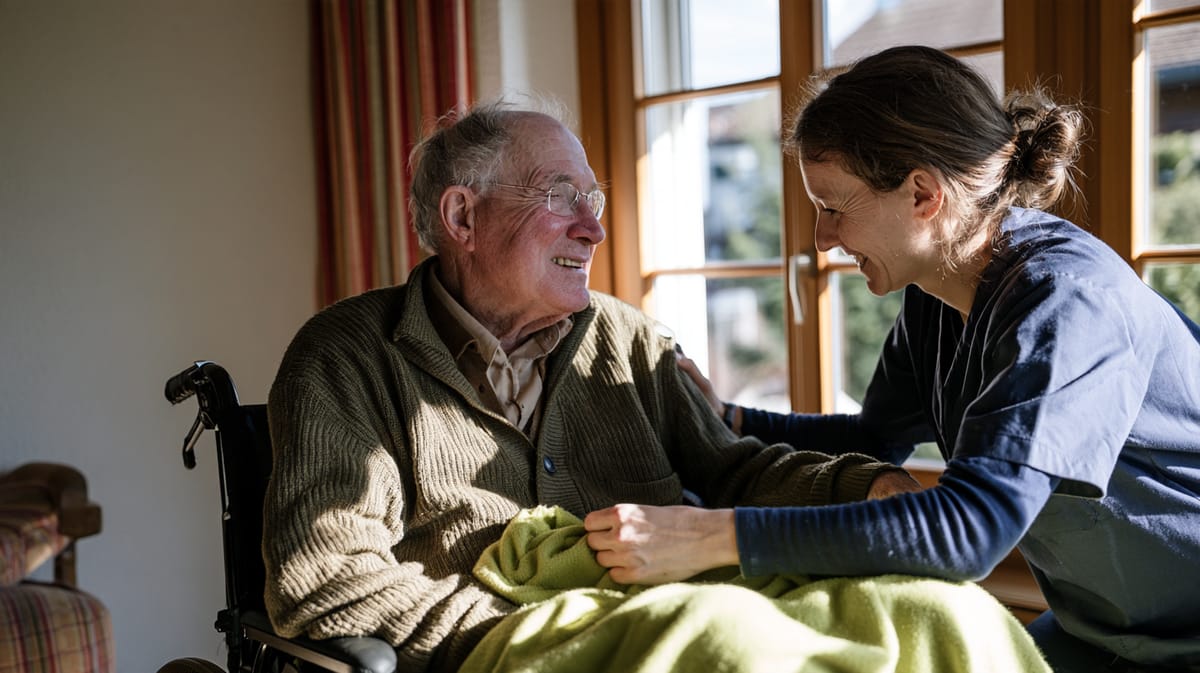
If your father, your partner or your child constantly needs help in daily life, with dressing, washing, eating, or because they cannot be left alone, there is money for that. From pension age the AHV pays CHF 252, CHF 630 or CHF 1'008 a month, before that the IV pays up to CHF 2'016. The check below shows in a minute the likely degree and how many hours of care the amount pays for.
Do you qualify, and how much is it?
5 short questions. Answer in francs per month, with start date and back pay.
1. Who needs help?
Who pays how much
Which insurance pays depends on when and why the need for help began. The amounts are the same across Switzerland, the canton makes no difference.
- Caused by an accidentAccident insurance
- Began before pension ageIV, continues afterwards
- Began after pension ageAHV
| Degree | AHV | IV at home | IV in a care home | Accident insurance |
|---|---|---|---|---|
| mild | CHF 252at home only | CHF 504 | CHF 126 | CHF 812 |
| moderate | CHF 630 | CHF 1'260 | CHF 315 | CHF 1'624 |
| severe | CHF 1'008 | CHF 2'016 | CHF 504 | CHF 2'436 |
per month
Children (IV): the same amounts as IV at home, calculated per day: CHF 16.80, 42.00 and 67.20. On top comes the intensive care supplement if a child needs at least 4, 6 or 8 hours more care per day: CHF 1'008, 1'764 or 2'520 per month.
For the IV, a care home means more than 15 days a month. In a care home the AHV keeps paying moderate and severe, not mild.
Claim and waiting period
The AHV or IV application goes to the IV office of your canton of residence, even if in the end the AHV pays. The IV office assesses, the compensation office pays out. If you regularly support or care for the person, you may submit the application for them. Have the person's AHV number ready for it.
- 1
Apply
At the IV office of your canton of residence, also for the AHV. Form 009.002 (AHV), 001.004 (IV, adults) or 001.005 (children).
- 2
Assessment
The IV office gets a medical report and often assesses at your home what help is needed and how much.
- 3
Decision
You receive the degree in writing. The allowance is paid monthly. If things get worse, ask for a review.
Do not wait too long: if you apply more than a year after the entitlement arose, the IV pays back at most the 12 months before the application.
After the application: visit, decision, review
The IV office assesses and decides in writing, even when the AHV pays in the end. If you disagree, you have 30 days each time. The application pack from the check has these steps on one page to print.
The assessment visit
Usually a specialist from the IV office visits the person, at home or in the care home, and asks act by act what help is needed, how often and for how long. How to prepare:
- Describe every limitation without playing anything down: an ordinary day and the bad days too.
- The person who helps most is there. In a care home, the specialist discusses the result with the nursing staff.
- Have a help diary for one week and the medical reports ready.
- Write down waking at night: it only counts if it is logged or confirmed in a medical report.
- Show the aids and say which help is still needed despite them.
The decision and the 30 days
With the IV (children included), a preliminary decision (Vorbescheid) comes first. If it is wrong, send the IV office your objection (Einwand) within 30 days, best as a letter: what you ask for and why, with the diary and a medical report. Then comes the formal decision (Verfügung). You can appeal against it within 30 days at the cantonal insurance court; this costs CHF 200 to 1'000.
With the AHV there is no preliminary decision: the IV office assesses the need for help, and the compensation office that pays the pension sends a formal decision (Verfügung) straight away. If it is wrong, lodge a formal objection (Einsprache) with that compensation office within 30 days, as a signed letter (an email is not enough) or orally. The objection is free of charge.
The 30 days run from the day after you receive the letter and cannot be extended; the deadline stated in the letter is what counts. If the degree is lower than expected, first ask for the file with the assessment report: a phone call to the IV office is enough.
Free advice: Pro Senectute for the AHV, Pro Infirmis and Inclusion Handicap (legal advice, also without membership) for the IV. Procap advises its members. Get in touch as soon as the letter comes, not at the end of the deadline.
Later: when more help is needed
If the person needs more help for good, ask in writing for a review, with what has changed since when and a medical report: for the IV at the IV office, for the AHV at the compensation office that pays. The increase counts once it has lasted three months, but the higher amount is paid at the earliest from the month of the request. So waiting costs money. A move into a care home must be reported.
What you can do with the money
The allowance is a fixed amount per month, not a refund of bills. This is what else it touches:
Free to use
The allowance belongs to the person who needs help and is meant to leave them the choice of how they are helped. For example with hours of a carer.
Supplementary benefits
As a rule it does not count as income for EL (Art. 11 para. 3 ELG).
Taxes
Federal tax: instead of actual costs, a flat deduction of CHF 2'500, 5'000 or 7'500 per year (tax year 2026; from 2027 it is CHF 6'000 and 9'500 for moderate and severe). If you deduct actual costs, you subtract the allowance from them.
Assistance contribution (IV)
Adults with an IV allowance at home: CHF 35.30 per hour for an assistant they employ themselves, not a spouse or direct relative.
Care credits
If you care for a relative who receives a helplessness allowance, you can get AHV care credits. That improves your own pension.
If you use the money to employ someone
Then you are an employer, even as a private household: AHV registration from the first franc, accident insurance for every employee (from 8 hours a week also for non-work accidents), a payslip every month and the wage certificate at year end (in the simplified procedure the compensation office sends her a confirmation of the withholding tax deduction instead). The employment contract for care work shows what belongs in the contract. Whether Spitex or a private carer suits you better is covered in the comparison of Spitex and private care.
We do the carer's registration with you
Clino prepares the AHV registration and walks you through it, creates the payslip every month and the wage certificate at year end. That leaves more time for the person who matters. Nothing is charged before day 30.
Try free for 30 daysFrequently asked questions
Does the helplessness allowance depend on income or assets?
Is the helplessness allowance also paid in a care home?
How long do you have to wait?
What happens to the IV allowance at pension age?
Can I use the helplessness allowance to pay a carer?
What does the helplessness allowance mean for the tax deduction?
Sources
- Fact sheet 3.01: old-age pensions and helplessness allowances of the AHV, as of 2026 - ahv-iv.ch
- Fact sheet 4.13: helplessness allowances of the IV (German) - ahv-iv.ch
- FSIO: amounts valid from 1 January 2026 - bsv.admin.ch
- AHVG Art. 43bis (entitlement, waiting period, amount) - fedlex.admin.ch
- IVG Art. 42 to 42ter and IVV Art. 37 to 39 (degrees, children, intensive care supplement) - fedlex.admin.ch
- UVV Art. 22 and 38 (accident insurance) - fedlex.admin.ch
- Federal compensation office: apply to the IV office, form 009.002 - eak.admin.ch
- Federal Tax Administration circular no. 11a, 2026 (disability-related costs) - estv.admin.ch
- ELG Art. 11 (supplementary benefits) - fedlex.admin.ch
- ATSG Art. 38, 40, 47 and 52 (deadlines, access to the file, formal objection) - fedlex.admin.ch
- IVG Art. 57a and 69 (preliminary decision, appeal, costs) - fedlex.admin.ch
- IVV Art. 77 and 87 to 88bis (duty to report, review) - fedlex.admin.ch
- AHVV Art. 69quater to 70bis and 125bis (AHV: decision by the compensation office, duty to report) - fedlex.admin.ch
- FSIO: circular on helplessness (KSH), 2026 edition (assessment, waking at night, review) - sozialversicherungen.admin.ch