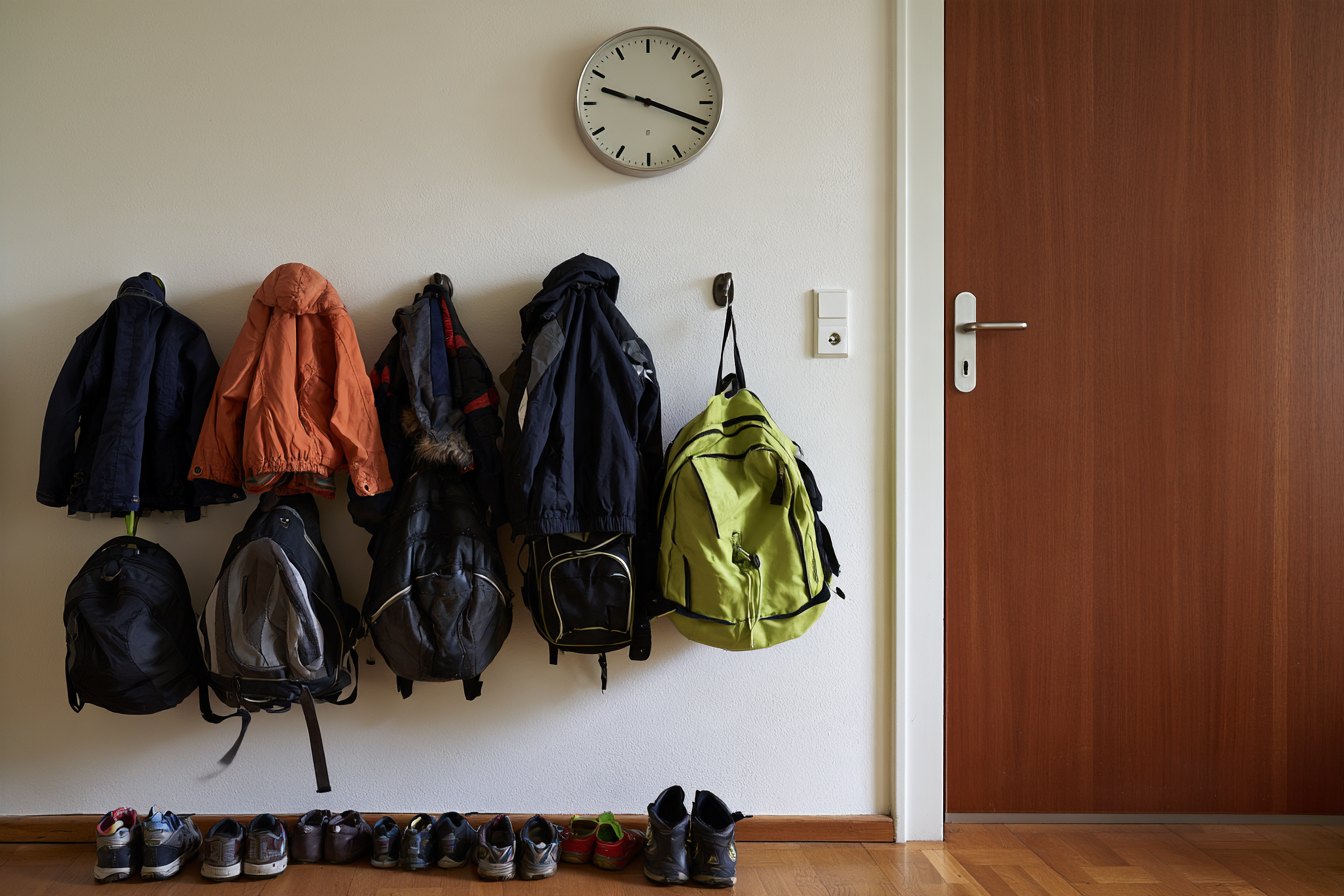
Nanny Support Compared: France Covers More Than Half the Cost, Switzerland Offers Only a Tax Deduction
France, Finland, Denmark and the United Kingdom support families even when they employ a carer in their own household. Switzerland funds daycare centres and childminders (day families), but not the nanny at home: what remains is the tax deduction for third-party childcare. Clino looked up the 2026 rules on the official websites of the five countries and worked them through for a two-year-old child.
Summary
In many European countries, childcare at home is a recognised form of childcare. Families who employ a carer register her, pay wages and social contributions, and in return get part of the cost back from the state, much like parents with a daycare place. Clino examined four countries that do this and compared them with Switzerland.
France goes furthest: for a family with a monthly income of EUR 4,000 and a full-time nanny at the minimum wage, the state covers at least 51.4 % of the employer cost. Denmark and Finland pay fixed monthly amounts if the municipality has approved the carer. In the United Kingdom, the help for a nanny is small, 6.6 % of the cost, but it exists.
In Switzerland, there is no subsidy for a nanny employed directly by the family, neither from the federal government nor in the cities we checked. What remains is the tax deduction for third-party childcare. In the worked example it is worth around CHF 183 a month on the direct federal tax, 3.6 % of the cost; the cantonal tax comes on top.
The five countries compared
Worked example for all countries: one child aged two, both parents working, one carer employed full time by the family (around 40 hours per week), 2026 rules. We only state the share of the cost where an official wage floor exists; Finland and Denmark have no statutory minimum wage.
Worked example 2026, full time, middle income. France: CMG and tax credit, without the 50% coverage of social contributions. Denmark: maximum, at most 75% of the cost. Finland: Kela plus Helsinki supplement, without the income-tested supplement. United Kingdom: Tax-Free Childcare. Switzerland: no subsidy; saving on the direct federal tax through the deduction (taxable income CHF 150,000), cantonal tax not included. Converted at ECB reference rates of 29.10.2026.
| Country | Instrument | Who receives it | Per month (example) | Share of the cost | Conditions |
|---|---|---|---|---|---|
| France | CMG emploi direct and 50% tax credit (Art. 199 sexdecies CGI) | Working parents, child under 6 | at least EUR 1,485 (CHF 1,369) | ≥ 51.4 % | The family is the employer and registers the nanny via Pajemploi; hourly wages above EUR 15.18 are not subsidised |
| Denmark (Copenhagen) | Tilskud til privat pasning (Dagtilbudsloven § 80) | Parents, instead of a nursery place | up to DKK 8,909 (CHF 1,099) | no official wage reference | The municipality approves and supervises the care; subsidy at most 75% of the documented cost; at most 5 children |
| Finland (Helsinki) | Yksityisen hoidon tuki (Kela) and municipal supplement | The family, paid out to the carer | EUR 692 (CHF 638) | no official wage reference | Employment contract, the municipality approves the carer, she does not live in the household; Helsinki supplement from 25 hrs/week |
| United Kingdom | Tax-Free Childcare (20% top-up) | Both parents working, each with an income of at most GBP 100,000 | GBP 167 (CHF 184) | 6.6 % | Nanny registered with Ofsted (voluntary register) and signed up to Tax-Free Childcare |
| Switzerland | No subsidy; deduction for third-party childcare (DBG Art. 33 para. 3) | Both parents working, child under 14 | CHF 183 (federal tax only) | 3.6 % | Only the childcare share of the wage is deductible; in the canton of Bern a flat half of the net wage |
France: the nanny as a childcare place
Since 1 September 2025, the CMG for a nanny at home (garde à domicile) has been calculated hour by hour, as for a crèche: the family pays an hourly amount that depends on income and the number of children, and the family allowance fund (CAF) pays the rest of the net wage. For one child, the rate is 0.1238% of monthly income per hour, based on a reference cost of EUR 10.50 per hour. The 15% minimum contribution previously required from the family has been abolished. Hourly wages up to EUR 15.18 are subsidised.
In the worked example, the nanny earns the sector minimum wage, EUR 12.89 gross per hour. Including all contributions, the family pays around EUR 2,891 a month. With an income of EUR 4,000 a month, the CMG pays EUR 922. On top of this comes the tax credit of 50% of the remaining cost, capped at EUR 13,500 a year for one child: EUR 563 a month. Together that is at least EUR 1,485, 51.4 % of the cost.
In addition, the CAF covers half of the social contributions, up to a monthly ceiling. We could not confirm the amount of this ceiling for 2026 on any official website; without a ceiling, the share would be 71.2 %. In 2026, the tax credit for children under six is not paid in advance but in the following year.
Finland: money to the carer, a supplement from the city
The Finnish social insurance institution Kela pays EUR 192.28 a month for a child in private care, plus a supplement of up to EUR 265.85 for low incomes. The money goes directly to the carer. If the family employs her itself, an employment contract is required and the municipality must approve the carer. She may not live in the same household.
Cities add their own supplements. Since 1 March 2026, Helsinki has paid EUR 500 a month for a child under three cared for by an employed carer, if the care covers more than 25 hours per week. Together with Kela, that makes EUR 692.28 for middle and high incomes and up to EUR 1018.13 for low incomes. Espoo pays EUR 560, Tampere EUR 400, Vantaa EUR 240. Neither Kela nor Helsinki sets a minimum wage for the carer; the family negotiates it and pays employer contributions on the full wage.
Denmark: a subsidy instead of a nursery place
Danish municipalities must offer parents a subsidy for private childcare as an alternative to a nursery place (Dagtilbudsloven § 80). The municipality approves the agreement between the parents and the carer and supervises it. The subsidy amounts to at least 75% of the net operating cost of a place with a municipal childminder and at most 75% of the parents’ documented costs. It is tax-free for the parents.
In Copenhagen, since 1 May 2026, it has been DKK 8,909 a month for a child up to the age of three years and one month, with care of at least 30 hours per week. The full amount is paid if the care costs at least DKK 11,879; parents pay for more expensive care themselves. Copenhagen describes the carers as self-employed. The law, however, also provides for parents as employers, and Aarhus explicitly allows this, with DKK 7,439 a month. For comparison: a nursery place in Copenhagen costs parents DKK 3,555 a month, without lunch.
United Kingdom: little, but for the registered nanny
Through Tax-Free Childcare, the state adds GBP 2 for every GBP 8 that parents pay in, up to GBP 2,000 per child per year. The account can also be used to pay a nanny if she is on the voluntary part of the Ofsted register (first aid, criminal record check, basic training, liability insurance, fee of GBP 103 a year). The state-funded free childcare hours, by contrast, do not apply to nannies.
A full-time nanny at the statutory minimum wage of GBP 12.71 costs the family around GBP 2,522 a month including employer contributions and pension. Tax-Free Childcare covers at most GBP 167, 6.6 % of this. Low-income families can instead receive up to 85% of the cost through Universal Credit, at most GBP 1071.09 a month for one child.
Switzerland: subsidies for daycare, a tax deduction for the nanny
The daycare subsidies of the cities we checked apply only to daycare centres and childminders (day families). In Bern, childcare vouchers are valid “only in daycare centres and with childminder organisations”; the canton of Bern states that “no childcare vouchers are issued” for a nanny. The canton of Lucerne answers the question of whether vouchers are available for a nanny with “No”. Zurich and Basel-Stadt subsidise places in daycare centres and with childminders (day families); they do not mention nannies.
The new federal law, which introduces a childcare allowance of at least CHF 100 per weekly day of childcare (CHF 500 a month for five days), also leaves out the nanny. The FSIO writes: “Grandparents and nannies are not covered”. The law was passed in December 2025; the date it will come into force has not yet been set.
What remains is the deduction for third-party childcare: for the 2026 direct federal tax, at most CHF 25,800 per child (2027: CHF 25,900); in the cantons the cap varies, CHF 16,000 in Bern and CHF 26,000 in Basel-Stadt. Only the part of the wage that relates to childcare during the parents’ working hours is deductible; the canton of Bern applies a flat half of the net wage. For a married couple with a taxable income of CHF 150,000, the full federal deduction saves CHF 2,191 a year, around CHF 183 a month. A full-time nanny in Bern costs around CHF 5,015 a month. With the cantonal tax, the saving is larger; in our study on the nanny tax deduction, it came to CHF 7,447 (Bern) and CHF 8,447 (Basel) a year for a family with two children and a gross income of CHF 150,000.
For one child, daycare in Switzerland remains clearly cheaper than a nanny; from the second child, this reverses in Bern and Basel (study Nanny or Daycare). Even so, only daycare is subsidised.
What we do not know
For France, the amount of the ceiling up to which the CAF covers half of the social contributions in 2026 is missing; we therefore only state the confirmed part, as a lower bound. The French sources disagree on whether the monthly cost in the CMG calculator means the net wage or the wage including contributions; like the CAF, we calculate with the net wage. In Copenhagen, the city only describes self-employed carers; we found no confirmation of whether it also pays the subsidy when the parents are the employers. For Switzerland, we checked the cities of Bern, Lucerne, Zurich and Basel and the cantons of Bern, Lucerne and Zug, not all municipalities. We did not calculate the cantonal tax for this worked example.
What families in Switzerland can do
Families who employ a nanny can only deduct the childcare costs if they are documented: with a salary statement, registration with the compensation office (AHV) and accident insurance. Childcare paid off the books is not deductible. Our guide Hiring a nanny explains the employment step by step. Clino guides families through the contract, registration, insurance and payroll.
“In France, a nanny at home counts as a childcare place, and the state contributes. In Switzerland, the family bears the cost almost alone.”
Quellen
- Urssaf and family allowance fund CAF: CMG emploi direct, reference costs and ceilings; contribution rates for private households (2026)
- service-public.gouv.fr: tax credit for household employment (F12), CMG (F39152) (2026)
- Kela: Yksityisen hoidon tuki, amounts from 1 January 2026; City of Helsinki, Espoo, Vantaa, Tampere: municipal supplements (2026)
- Retsinformation: Dagtilbudsloven (LBK 1038/2025); Copenhagen and Aarhus: subsidy for private childcare (2026)
- gov.uk: Tax-Free Childcare, National Minimum Wage, employer contributions, Universal Credit; Ofsted (2026/27)
- FTA: circular letter 2-215-D-2025, Circular No. 30; FSIO: UKibeG; Bern tax administration (2010-2026)
- City of Bern, Canton of Bern, Canton of Lucerne, City of Zurich, Basel-Stadt: childcare vouchers and daycare contributions (2026)
- ECB: euro reference rates of 29 October 2026 (2026)
Do you represent an organization supporting households or workers?
Become a partner →Further Resources
Press Contact
Media inquiries, interviews, background information
Press photo
About Clino
Clino is a Swiss SaaS platform enabling households to legally employ domestic workers: payroll, contract and AHV registration; Clino guides the household, insurance stays with the household. CHF 19.90/month. All 26 cantons. Founded 2026 in Zurich. clino.ch