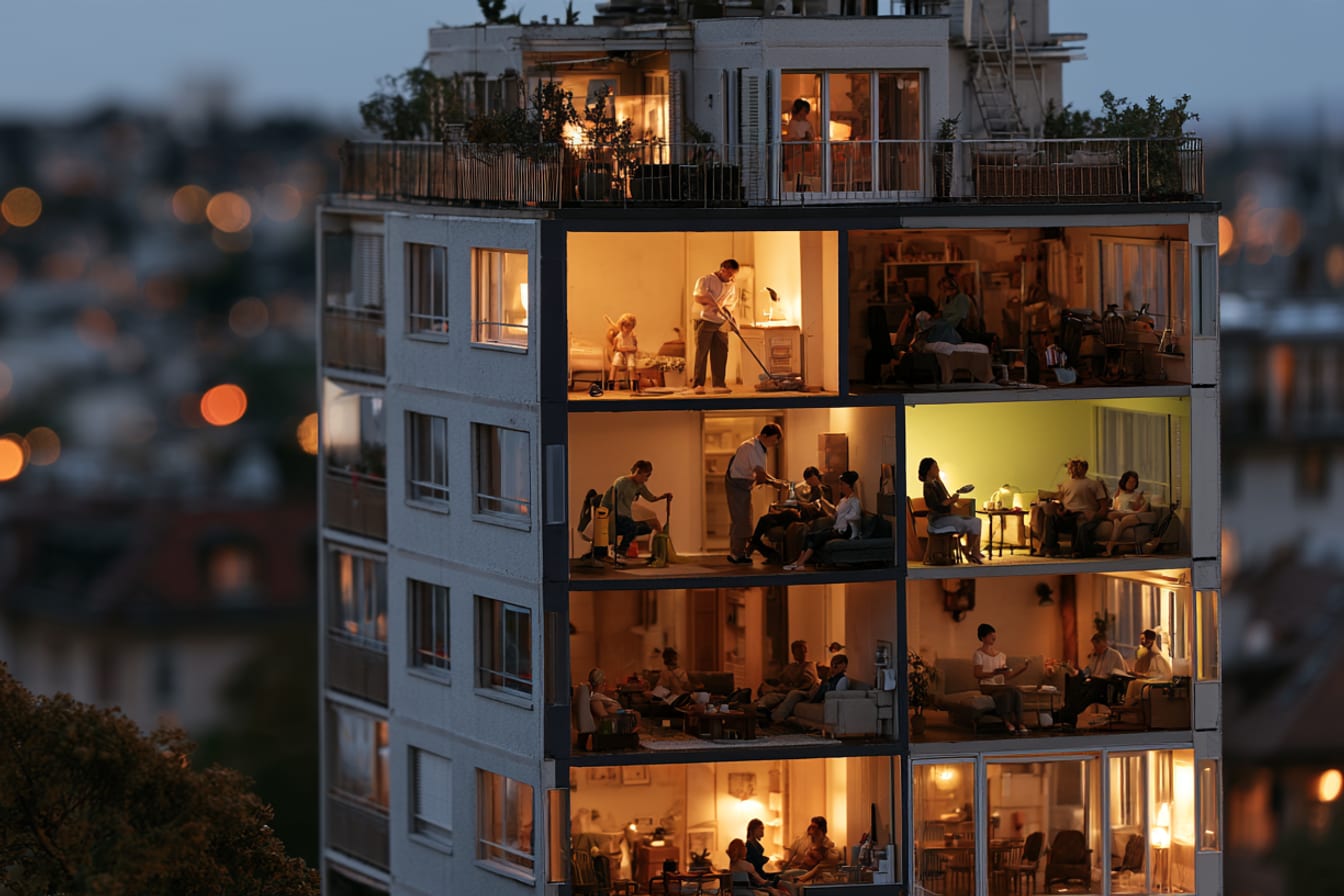
Nine in Ten Cross-Border Permits for Private Households Go to Women: Across All Sectors It Is Just Over One in Three
At the end of September 2026, 5,790 cross-border permits for work in a private household were valid in Switzerland. 5,163 of them, 89%, are held by women; across all sectors the share is 35%. In no other sector is it as high. More than half, 3,030, are valid in Ticino: there, one cross-border permit in 29 is for a private household, in Geneva one in 153. A valid permit does not mean the person is currently working: the Federal Statistical Office puts the number of commuters at work at 4,638. All border cantons compared.
Summary
Anyone who lives abroad and works in Switzerland needs a cross-border permit (G permit). Every month the State Secretariat for Migration (SEM) reports the sector in which these permits are valid. The sector “domestic services”, meaning work directly for a private household, counted 5,790 valid permits on 30 September 2026. That is 1.2% of all 480,820 cross-border permits. 3,237 are held by Italian nationals, 1,440 by French, 428 by German and 24 by Austrian nationals, 661 by nationals of other countries.
Two things stand out. First, the share of women: 89%, compared with 35% across all sectors. Second, the distribution: 3,030 permits are valid in Ticino, 887 in Geneva, 335 in Basel-Landschaft, 306 in Vaud and 277 in Basel-Stadt.
A valid permit is not the same as a person who is currently working: the permit is generally valid for five years, and those who give up the job do not always report it. The Federal Statistical Office (FSO) therefore estimates the number of people actually at work. For private households it arrives at 4,638 people in the 3rd quarter of 2026, 80% of the permits. Both figures have been falling since 2022. And contrary to what is often assumed, the sector has grown more slowly than cross-border employment as a whole.
Ticino ahead of Geneva: in Ticino, one cross-border permit in 29 is for a private household, in Geneva one in 153
22 cantons have at least one cross-border permit for a private household, 4 have none at all. Ticino alone counts 3,030, more than all other cantons combined (2,760), followed by Geneva with 887 (15%). The ranking shows three numbers for each canton: the valid permits, their weight among all the canton’s cross-border permits and the number ten years ago. It counts permits by canton of work, not people at work.
Largest rise since 2016: Vaud (+219%). Largest fall: Schaffhausen (−60%).
- 1Ticino3,030
1 in 29 of the canton’s G permits · 2016: 2,870 +6%
- 2Geneva887
1 in 153 of the canton’s G permits · 2016: 458 +94%
- 3Basel-Country335
1 in 92 of the canton’s G permits · 2016: 439 −24%
- 4Vaud306
1 in 181 of the canton’s G permits · 2016: 96 +219%
- 5Basel-City277
1 in 157 of the canton’s G permits · 2016: 550 −50%
- 6Thurgau239
1 in 33 of the canton’s G permits · 2016: 23
- 7Grisons229
1 in 50 of the canton’s G permits · 2016: 160 +43%
- 8Jura125
1 in 113 of the canton’s G permits · 2016: 15
- 9Zurich95
1 in 155 of the canton’s G permits · 2016: 72 +32%
- 10Aargau75
1 in 257 of the canton’s G permits · 2016: 99 −24%
- 11Valais65
1 in 117 of the canton’s G permits · 2016: 21
- 12Schaffhausen27
1 in 256 of the canton’s G permits · 2016: 67 −60%
- 13Bern22
1 in 249 of the canton’s G permits · 2016: 7
- 14St. Gallen20
1 in 637 of the canton’s G permits · 2016: 30
Other cantons: 15. Neuchâtel 19 · 16. Fribourg 11 · 17. Zug 8 · 18. Solothurn 7 · 19. Nidwalden 5 · 20. Schwyz 4 · 21. Obwalden 3 · 22. Lucerne 1. No permit: Appenzell Inner Rhodes, Appenzell Outer Rhodes, Glarus, Uri.
Valid cross-border permits (G permits) in the sector “domestic services” on 30.09.2026 by canton of work, share of all the canton’s G permits and number on 30.09.2016. Percentage change only from 50 permits in 2016. A valid permit does not mean the person is working at present. Source: SEM, foreign-resident statistics, table 5-20 (30.09.2026) · Chart: Clino
Measured against all cross-border permits in a canton, the figures show where the private household carries weight as an employer. In Ticino it is 3.49%, in Thurgau 3.01%, in Graubünden 2.00%. In Geneva, the canton with the most cross-border commuters in Switzerland, it is 0.65%.
The darker, the higher the share of “domestic services” among all valid cross-border permits (30.09.2026). Cantons with fewer than 20 such permits are grey. Source: SEM, foreign-resident statistics, table 5-20 (30.09.2026) · Chart: Clino
Nine in ten permits go to women: no sector is more female
Of the 5,790 permits, 5,163 are held by women and 627 by men. At 89.2%, the sector is far ahead of the next one, the clothing industry with 73.2%. The FSO estimate of commuters at work confirms the picture: 88.9% women in private households, 71.4% in the next economic division, residential care homes. The share of men is rising, however: at the end of 2008, 219 permits were held by men (5.7%), today it is 627 (10.8%).
| # | Share of women | |
|---|---|---|
| 1 | Domestic services (private households)5,790 permits | 89.2% |
| 2 | Clothing2,754 permits | 73.2% |
| 3 | Residential homes and welfare11,029 permits | 72.2% |
| 4 | Medicine and health care39,042 permits | 70.8% |
| 5 | Religious and philosophical associations986 permits | 59.3% |
| 6 | Embassies and international missions128 permits | 58.6% |
| 7 | Personal services12,329 permits | 58.4% |
| 8 | Leather goods355 permits | 56.1% |
Share of women among valid cross-border permits by SEM sector, 30.09.2026. The eight highest of 54 sectors with at least 100 permits. All sectors together: 35%. Source: SEM, foreign-resident statistics, table 5-20 (30.09.2026) · Chart: Clino
The border determines the passport: Italian women in Ticino, French women in Geneva and Basel-Landschaft
In Ticino, 2,882 of 3,030 permits are held by Italian nationals, 2,709 of them by women. In Graubünden it is 216 of 229. In Geneva (609 of 887), in Vaud (253 of 306) and in Jura (123 of 125) the French passport dominates. The same is true of Basel-Landschaft, where 226 permits are held by French and 67 by German nationals. In Basel-Stadt the two are evenly balanced (117 and 116). In Geneva the group of other countries stands out: 228 permits, more than a quarter, are held by people who live abroad and have neither a French nor a German, Italian or Austrian passport.
Share of each nationality among valid cross-border permits for private households, 30.09.2026. Cantons with at least 50 permits. The passport is counted, not the country of residence.
| Italy | France | Germany | Austria | other countries | permits | |
|---|---|---|---|---|---|---|
| Ticino | 2882 | 3 | 1 | 0 | 144 | 3030 |
| Geneva | 48 | 609 | 1 | 1 | 228 | 887 |
| Basel-Country | 7 | 226 | 67 | 0 | 35 | 335 |
| Vaud | 5 | 253 | 4 | 1 | 43 | 306 |
| Basel-City | 10 | 116 | 117 | 0 | 34 | 277 |
| Thurgau | 1 | 24 | 85 | 6 | 123 | 239 |
| Grisons | 216 | 1 | 1 | 2 | 9 | 229 |
| Jura | 0 | 123 | 1 | 0 | 1 | 125 |
| Zurich | 5 | 2 | 72 | 1 | 15 | 95 |
| Aargau | 13 | 6 | 47 | 0 | 9 | 75 |
| Valais | 43 | 21 | 0 | 0 | 1 | 65 |
Source: SEM, foreign-resident statistics, table 5-20 (30.09.2026) · Chart: Clino
The sector has grown more slowly than cross-border employment as a whole
The assumption that more and more households rely on cross-border commuters is only half confirmed by the figures. Since 2002, the number of cross-border commuters at work in private households has risen from 3,127 to 4,638, by 48%. Across all sectors it more than doubled over the same period, from 164,718 to 414,488 (+152%). The same holds for permits: at the end of 2008, 3,867 were valid for private households, 1.53% of all cross-border permits. Today it is 1.20%.
Cross-border commuters at work, third quarter of each year, index 2002 = 100. The values for 2025 and 2026 are provisional.
| all sectors: 164,718 → 414,488 | private households (NOGA 97): 3,127 → 4,638 | |
|---|---|---|
| 2002 | 100 | 100 |
| 2003 | 103 | 102 |
| 2004 | 106 | 100 |
| 2005 | 107 | 92 |
| 2006 | 117 | 95 |
| 2007 | 127 | 100 |
| 2008 | 133 | 97 |
| 2009 | 135 | 95 |
| 2010 | 143 | 98 |
| 2011 | 155 | 102 |
| 2012 | 165 | 112 |
| 2013 | 173 | 108 |
| 2014 | 180 | 111 |
| 2015 | 185 | 117 |
| 2016 | 189 | 130 |
| 2017 | 195 | 135 |
| 2018 | 199 | 134 |
| 2019 | 206 | 137 |
| 2020 | 208 | 142 |
| 2021 | 216 | 150 |
| 2022 | 230 | 155 |
| 2023 | 241 | 152 |
| 2024 | 246 | 152 |
| 2025 | 247 | 150 |
| 2026 | 252 | 148 |
Source: FSO, cross-border commuter statistics (GGS), NOGA 97, provisional from 2025 · Chart: Clino
The peak has passed. On 30 September 2022 the SEM counted 6,053 valid permits, today there are 263 fewer. The FSO estimate reached its maximum in the 2nd quarter of 2022 with 4,858 people at work and is now 4.5% below that. For every 100 valid permits there are 80 people at work in private households, and 86 across all sectors.
Private households, all of Switzerland. Permits: valid cross-border permits on 30 September of each year (SEM). At work: FSO estimate for the third quarter, 2025 and 2026 provisional. A permit is normally valid for five years, even if the job ends.
| valid permits (SEM) | at work (FSO) | |
|---|---|---|
| 2009 | 3901 | 2957 |
| 2010 | 3969 | 3075 |
| 2011 | 4150 | 3174 |
| 2012 | 4351 | 3501 |
| 2013 | 4326 | 3364 |
| 2014 | 4507 | 3468 |
| 2015 | 4737 | 3665 |
| 2016 | 4964 | 4061 |
| 2017 | 5216 | 4224 |
| 2018 | 5053 | 4183 |
| 2019 | 5272 | 4290 |
| 2020 | 5537 | 4449 |
| 2021 | 5894 | 4706 |
| 2022 | 6053 | 4849 |
| 2023 | 5906 | 4756 |
| 2024 | 5903 | 4756 |
| 2025 | 5858 | 4683 |
| 2026 | 5790 | 4638 |
Source: SEM, foreign-resident statistics, table 5-20 (30.09.2026) · Source: FSO, cross-border commuter statistics (GGS), NOGA 97, provisional from 2025 · Chart: Clino
Ticino: peak in spring 2022, 8% fewer since then
In Ticino, 2,802 cross-border commuters worked in private households in the 2nd quarter of 2022, according to the FSO estimate. In the 3rd quarter of 2026 it is 2,570, 8.3% fewer. The values from 2025 onwards are provisional; up to the end of 2024, the last definitive figure, the decline since the 2nd quarter of 2023 was 4.4%.
The new cross-border commuter agreement between Switzerland and Italy entered into force on 17.07.2023 and has been applicable since 01.01.2024. Anyone who started working as a cross-border commuter in Ticino, Graubünden or Valais on or after 17.07.2023 is taxed at source in Switzerland at 80% of the usual rate and additionally in Italy, which credits the Swiss tax. A transitional arrangement applies to existing cross-border commuters.
Since the quarter before the agreement entered into force, the number in Ticino private households has fallen by 6.4%, and the number of all cross-border commuters in the canton by 1.9%. Permits show the same pattern: those for Italian nationals in Ticino private households fell from 3,119 to 2,882 between September 2022 and September 2026 (−7.6%), while those for Italian nationals in all sectors of the canton rose from 83,843 to 84,440 (+0.7%). Whether the agreement is the reason cannot be derived from these figures: the decline began as early as 2022, before the agreement entered into force, and in the 3rd quarter of 2023 permits in this sector also fell in Geneva and in both Basel cantons, where the agreement does not apply.
Cross-border commuters at work in private households in Ticino, by quarter. The axis starts at 2,000. The new cross-border agreement with Italy entered into force on 17.07.2023; the figures do not show whether it explains the decline.
| private households in Ticino (NOGA 97) | |
|---|---|
| 1/16 | 2461 |
| 2/16 | 2512 |
| 3/16 | 2507 |
| 4/16 | 2529 |
| 1/17 | 2555 |
| 2/17 | 2607 |
| 3/17 | 2618 |
| 4/17 | 2620 |
| 1/18 | 2623 |
| 2/18 | 2626 |
| 3/18 | 2618 |
| 4/18 | 2615 |
| 1/19 | 2662 |
| 2/19 | 2696 |
| 3/19 | 2663 |
| 4/19 | 2692 |
| 1/20 | 2678 |
| 2/20 | 2640 |
| 3/20 | 2693 |
| 4/20 | 2733 |
| 1/21 | 2763 |
| 2/21 | 2783 |
| 3/21 | 2745 |
| 4/21 | 2771 |
| 1/22 | 2781 |
| 2/22 | 2802 |
| 3/22 | 2788 |
| 4/22 | 2761 |
| 1/23 | 2755 |
| 2/23 | 2747 |
| 3/23 | 2697 |
| 4/23 | 2696 |
| 1/24 | 2696 |
| 2/24 | 2690 |
| 3/24 | 2637 |
| 4/24 | 2626 |
| 1/25 | 2624 |
| 2/25 | 2622 |
| 3/25 | 2606 |
| 4/25 | 2588 |
| 1/26 | 2589 |
| 2/26 | 2596 |
| 3/26 | 2570 |
Source: FSO, cross-border commuter statistics (GGS), NOGA 97, provisional from 2025 · Chart: Clino
Two decisions are pending that affect pay in Ticino private households. The cantonal minimum wage rises in stages from 2027: the amendment adopted by the cantonal parliament in spring 2026 sets a range of CHF 20.50 to 21.00 for 2027, of CHF 21.00 to 21.50 for 2028 and of CHF 21.75 to 22.25 for 2029 (transitional provision, report 8163 R of the Commissione gestione e finanze of 30 March 2026). For private households the cantonal decree names CHF 20.50 for 2027; whether the NAV continues to apply until 2028 to household staff working five hours a week or more is still open. Today, domestic workers in Ticino are covered by the minimum wage of the federal standard employment contract for domestic work (NAV Hauswirtschaft), CHF 20.35 an hour. And on 28.02.2027 Switzerland votes on whether minimum wages from collective labour agreements that have been declared generally binding take precedence over cantonal minimum wages. Domestic workers employed directly by a private household are not covered by a collective labour agreement but by the NAV Hauswirtschaft.
Geneva has roughly doubled since 2016, Basel-Stadt has halved: both statistics show it
Away from Ticino the map is shifting, and it does so in both statistics. Valid permits (SEM): On 30 September 2016, 458 cross-border permits for private households were valid in Geneva; ten years later there are 887 (+94%). In Vaud the number rose from 96 to 306. In Basel-Stadt it fell from 550 to 277 (−50%), in Basel-Landschaft from 439 to 335 (−24%).
Commuters actually at work (FSO estimate, third quarter of each year): Geneva 350 in 2016 and 712 today, Vaud 77 and 249, Basel-Stadt 381 and 190, Basel-Landschaft 335 and 244. The FSO figures are lower because not every valid permit has a current job behind it; the direction is the same in both statistics. In 2002 the FSO still counted 635 in Basel-Stadt and 104 in Geneva: Geneva has overtaken Basel-Stadt.
Cross-border commuters at work in private households, third quarter of each year. Without Ticino (separate chart). 2025 and 2026 provisional.
| Geneva | Vaud | Basel-Country | Basel-City | |
|---|---|---|---|---|
| 2002 | 104 | 21 | 428 | 635 |
| 2003 | 114 | 18 | 424 | 592 |
| 2004 | 119 | 24 | 427 | 560 |
| 2005 | 143 | 35 | 387 | 459 |
| 2006 | 162 | 36 | 404 | 471 |
| 2007 | 189 | 48 | 435 | 494 |
| 2008 | 211 | 45 | 384 | 436 |
| 2009 | 219 | 49 | 370 | 409 |
| 2010 | 230 | 46 | 390 | 422 |
| 2011 | 236 | 45 | 379 | 448 |
| 2012 | 256 | 62 | 412 | 484 |
| 2013 | 280 | 57 | 317 | 403 |
| 2014 | 286 | 60 | 315 | 375 |
| 2015 | 322 | 60 | 317 | 365 |
| 2016 | 350 | 77 | 335 | 381 |
| 2017 | 369 | 84 | 343 | 388 |
| 2018 | 401 | 81 | 330 | 347 |
| 2019 | 414 | 91 | 327 | 345 |
| 2020 | 479 | 124 | 326 | 367 |
| 2021 | 539 | 148 | 319 | 344 |
| 2022 | 591 | 173 | 301 | 309 |
| 2023 | 613 | 200 | 271 | 261 |
| 2024 | 649 | 193 | 254 | 225 |
| 2025 | 713 | 219 | 257 | 209 |
| 2026 | 712 | 249 | 244 | 190 |
Source: FSO, cross-border commuter statistics (GGS), NOGA 97, provisional from 2025 · Chart: Clino
The minimum wage does not explain this. At CHF 24.59 an hour, Geneva has the highest binding minimum wage for domestic workers; Vaud and both Basel cantons are at the NAV rate of CHF 20.35. Since the 3rd quarter of 2020, shortly before Geneva introduced its minimum wage on 1 November 2020, the number there has risen by 49%, and in Vaud, which has no cantonal minimum wage, by 101%. In the four years before that it had grown by 37% in Geneva. Five cantons with larger numbers are not enough to prove or rule out a link.
Thurgau: from 59 to 146 permits in one quarter, and the statistics give no reason
In September 2020, 19 cross-border permits for private households were valid in Thurgau. Between June and September 2021 the number rose from 59 to 146 in a single quarter, and at the end of 2024 it reached 365. Since then it has been falling again, to 239 (−35%). 51% of today’s permits are held by people who have neither a German nor a French, Italian or Austrian passport. We checked whether a reclassification from another sector explains the jump: in the same quarter no other sector in Thurgau lost more than 31 permits. The FSO estimate of commuters at work shows the rise too (third quarter 2020: 22, third quarter 2021: 121), although it draws in part on the same register. Neither statistic shows whether new employers, a different employment model or a change in recording lies behind it. The jump is unexplained and should be quoted as such.
Valid cross-border permits for private households in the canton of Thurgau, at the end of each quarter. The statistics do not show the reason for the rise.
| all permits | other countries | German passport | |
|---|---|---|---|
| 2019 | 14 | 5 | 8 |
| 2019 | 17 | 7 | 9 |
| 2019 | 16 | 6 | 9 |
| 2019 | 20 | 10 | 9 |
| 2020 | 20 | 10 | 9 |
| 2020 | 20 | 9 | 10 |
| 2020 | 19 | 8 | 10 |
| 2020 | 37 | 12 | 23 |
| 2021 | 50 | 16 | 30 |
| 2021 | 59 | 18 | 36 |
| 2021 | 146 | 43 | 94 |
| 2021 | 168 | 55 | 102 |
| 2022 | 178 | 62 | 104 |
| 2022 | 188 | 64 | 111 |
| 2022 | 199 | 68 | 118 |
| 2022 | 221 | 80 | 122 |
| 2023 | 230 | 86 | 123 |
| 2023 | 244 | 96 | 128 |
| 2023 | 244 | 97 | 127 |
| 2023 | 271 | 106 | 142 |
| 2024 | 298 | 124 | 149 |
| 2024 | 334 | 156 | 151 |
| 2024 | 343 | 157 | 145 |
| 2024 | 365 | 172 | 145 |
| 2025 | 344 | 168 | 130 |
| 2025 | 329 | 159 | 126 |
| 2025 | 302 | 144 | 118 |
| 2025 | 272 | 133 | 103 |
| 2026 | 261 | 129 | 97 |
| 2026 | 247 | 125 | 90 |
| 2026 | 239 | 123 | 85 |
Source: SEM, foreign-resident statistics, table 5-20, editions March 2019 to September 2026 · Chart: Clino
Wage gap: the Swiss minimum wage for household staff is 3.2 times the Italian rate
One obvious explanation for Ticino’s weight is the wage gap. The federal standard contract for domestic work (NAV Hauswirtschaft) prescribes CHF 20.35 an hour for unskilled staff. Italy has no statutory minimum wage; the minimum rate of the national collective agreement for domestic work is EUR 7.01 in 2026 (level B, not living in), or CHF 6.44. The French SMIC has been EUR 12.31 since 1 June 2026 (CHF 11.31), the German minimum wage is EUR 13.90 (CHF 12.77). The Swiss rate is therefore 3.2 times the Italian, 1.8 times the French and 1.6 times the German one. Geneva’s minimum wage of CHF 24.59 is 2.2 times the SMIC.
| Geneva, cantonal minimum wage | CHF 24.59 |
| Switzerland, NAV Hauswirtschaft (unskilled) | CHF 20.35 |
| Germany, statutory minimum wage (EUR 13.90) | CHF 12.77 |
| France, SMIC (EUR 12.31) | CHF 11.31 |
| Italy, domestic-work agreement, level B (EUR 7.01) | CHF 6.44 |
Prescribed gross hourly wage without holiday pay, in Swiss francs. Converted at the European Central Bank reference rate of 23.11.2026 (1 euro = CHF 0.9186). Italy has no statutory minimum wage; shown is the minimum rate of the national collective agreement for domestic work, level B, not living in. Purchasing power, deductions and the commute are not taken into account.
Sources: Fedlex (NAV Hauswirtschaft), Canton of Geneva, Mindestlohnkommission (DE), Service-Public.fr (FR), Ministero del Lavoro (IT), ECB · Chart: Clino
The permits fit the direction of this gap: of all cross-border permits held by Italian nationals, one in 33 is for a private household; for French nationals it is one in 177, for German nationals one in 181. That is not proof. Three neighbouring countries are three data points, France and Germany show no difference despite different wage gaps, and language, distance, ageing and the economic structure of the border regions also play a part. The comparison also uses prescribed minimum rates, not wages paid, and leaves out purchasing power and deductions.
Ticino: one cross-border commuter in a private household for every 11 residents aged 80 and over
Ticino is the oldest canton in Switzerland: 8.0% of the population are 80 or older, 28,770 people. Set against them are 2,570 cross-border commuters at work in private households, one person for roughly every 11 residents aged 80 and over. In Geneva it is one for every 41, in Vaud one for every 178. This is a ratio and not a statement about whom these people care for: the statistics record only the sector, not the activity. The sector includes cleaning, cooking, childcare and care of the elderly. More on the ageing of the canton can be found in the study on Ticino as the oldest canton.
| # | per 1,000 aged 80+ | |
|---|---|---|
| 1 | Ticino2,570 commuters · 28,770 people aged 80+ (8.0% of the population) | 89.3 |
| 2 | Geneva712 commuters · 29,320 people aged 80+ (5.5% of the population) | 24.3 |
| 3 | Jura96 commuters · 4,852 people aged 80+ (6.5% of the population) | 19.8 |
| 4 | Basel-City190 commuters · 13,387 people aged 80+ (6.7% of the population) | 14.2 |
| 5 | Grisons180 commuters · 13,652 people aged 80+ (6.6% of the population) | 13.2 |
| 6 | Basel-Country244 commuters · 22,224 people aged 80+ (7.4% of the population) | 11.0 |
| 7 | Thurgau137 commuters · 15,461 people aged 80+ (5.2% of the population) | 8.9 |
| 8 | Vaud249 commuters · 44,404 people aged 80+ (5.2% of the population) | 5.6 |
| 9 | Valais48 commuters · 21,405 people aged 80+ (5.8% of the population) | 2.2 |
| 10 | Aargau51 commuters · 38,231 people aged 80+ (5.2% of the population) | 1.3 |
| 11 | Zurich68 commuters · 87,278 people aged 80+ (5.4% of the population) | 0.8 |


Cross-border commuters at work in private households (FSO, third quarter 2026, provisional) per 1,000 residents aged 80 and over (FSO STATPOP, end 2024). Cantons with at least 50 permits. A ratio, not a statement about whom these people look after: the statistics do not record their job.
All cantons at a glance
| Canton | Permits 30.09.2026 | of which women | Italy | France | Germany | Austria | Other | Share of all G permits | At work Q3 2026 (FSO) | At work Q3 2016 | Household minimum wage 2026 (CHF/h) |
|---|---|---|---|---|---|---|---|---|---|---|---|
| Ticino | 3,030 | 2,848 | 2,882 | 3 | 1 | 0 | 144 | 3.49% | 2,570 | 2,507 | 20.35 |
| Geneva | 887 | 745 | 48 | 609 | 1 | 1 | 228 | 0.65% | 712 | 350 | 24.59 |
| Basel-Country | 335 | 290 | 7 | 226 | 67 | 0 | 35 | 1.09% | 244 | 335 | 20.35 |
| Vaud | 306 | 204 | 5 | 253 | 4 | 1 | 43 | 0.55% | 249 | 77 | 20.35 |
| Basel-City | 277 | 256 | 10 | 116 | 117 | 0 | 34 | 0.64% | 190 | 381 | 20.35 |
| Thurgau | 239 | 215 | 1 | 24 | 85 | 6 | 123 | 3.01% | 137 | 18 | 20.35 |
| Grisons | 229 | 205 | 216 | 1 | 1 | 2 | 9 | 2.00% | 180 | 133 | 20.35 |
| Jura | 125 | 116 | 0 | 123 | 1 | 0 | 1 | 0.89% | 96 | 10 | 20.35 |
| Zurich | 95 | 58 | 5 | 2 | 72 | 1 | 15 | 0.64% | 68 | 48 | 20.35 |
| Aargau | 75 | 72 | 13 | 6 | 47 | 0 | 9 | 0.39% | 51 | 70 | 20.35 |
| Valais | 65 | 56 | 43 | 21 | 0 | 0 | 1 | 0.86% | 48 | 13 | 20.35 |
| Schaffhausen | 27 | 23 | 1 | 0 | 22 | 1 | 3 | 0.39% | 19 | 47 | 20.35 |
| Bern | 22 | 15 | 2 | 17 | 1 | 0 | 2 | 0.40% | 19 | 6 | 20.35 |
| St. Gallen | 20 | 18 | 0 | 0 | 4 | 11 | 5 | 0.16% | 14 | 22 | 20.35 |
| Neuchâtel | 19 | 10 | 0 | 17 | 0 | 0 | 2 | 0.10% | 14 | 1 | 21.35 |
| Fribourg | 11 | 7 | 0 | 11 | 0 | 0 | 0 | 0.42% | 9 | 7 | 20.35 |
| Zug | 8 | 8 | 1 | 4 | 1 | 0 | 2 | 0.39% | 6 | 1 | 20.35 |
| Solothurn | 7 | 7 | 0 | 3 | 0 | 0 | 4 | 0.23% | 5 | 19 | 20.35 |
| Nidwalden | 5 | 2 | 3 | 0 | 2 | 0 | 0 | 2.29% | 3 | 0 | 20.35 |
| Schwyz | 4 | 4 | 0 | 3 | 0 | 1 | 0 | 0.56% | 3 | 11 | 20.35 |
| Obwalden | 3 | 3 | 0 | 1 | 1 | 0 | 1 | 1.78% | 2 | 2 | 20.35 |
| Lucerne | 1 | 1 | 0 | 0 | 1 | 0 | 0 | 0.10% | 1 | 1 | 20.35 |
| Appenzell Inner Rhodes | 0 | 0 | 0 | 0 | 0 | 0 | 0 | 0.00% | 0 | 0 | 20.35 |
| Appenzell Outer Rhodes | 0 | 0 | 0 | 0 | 0 | 0 | 0 | 0.00% | 0 | 2 | 20.35 |
| Glarus | 0 | 0 | 0 | 0 | 0 | 0 | 0 | 0.00% | 0 | 0 | 20.35 |
| Uri | 0 | 0 | 0 | 0 | 0 | 0 | 0 | 0.00% | 0 | 0 | 20.35 |
| Switzerland | 5,790 | 5,163 | 3,237 | 1,440 | 428 | 24 | 661 | 1.20% | 4,638 | 4,061 |
Permits: valid cross-border permits in the sector “domestic services” by canton of work and nationality (SEM, table 5-20). At work: FSO estimate for NOGA 97, rounded, 2026 provisional; uncertain for small numbers. Minimum wage: binding hourly wage for unskilled workers from five hours a week (NAV Hauswirtschaft or a higher cantonal minimum wage).
Surprising findings
Vaud: from 96 to 306 permits in ten years
Among the cantons that had at least 50 cross-border permits for private households in 2016, none has grown faster (+219%). At the other end is Schaffhausen: from 67 to 27 (−60%).
One permit in five has no one at work behind it
For 5,790 valid permits there are 4,638 people at work according to the FSO estimate, 80%. Across all sectors it is 86%. This suggests that in private households a valid permit is less often backed by a current job. Part of the difference, however, may arise because the two statistics do not define the sector in exactly the same way.
The share of men has almost doubled
At the end of 2008, 5.7% of permits for private households were held by men, today it is 10.8%. In Zurich (37 of 95) and in Vaud (102 of 306), at least one permit in three is issued to a man.
What the data do not show
- The activity. Both statistics record the sector of the employer, not the occupation. Whether someone cleans, looks after children or cares for an elderly person is not recorded anywhere.
- Working hours and pay. A permit says nothing about hours or the hourly wage. Many domestic workers work for several households; the person is counted once.
- Agencies and cleaning companies. Anyone employed by a care agency or a cleaning company and working in households is counted in a different sector.
- Undeclared work. Anyone working without a permit and without being registered appears in neither of the two statistics.
- The cause of the decline in Ticino. Tax agreement, exchange rate, wages in Italy, ageing of permit holders or a clean-up of the register: the figures do not distinguish between these explanations.
Questions for the authorities
- To the SEM: how is the sector “domestic services” assigned to a permit, and is it updated when the holder changes jobs? What explains the decline of 146 permits between June and September 2023?
- To the FSO: how reliable is the estimate for economic division 97 in individual cantons, and how many of these jobs are handled through the simplified settlement procedure?
- To the canton of Ticino: how many of the cross-border permits issued since 17.07.2023 are for private households, compared with the years before?
- To the canton of Thurgau (migration office): what explains the rise in cross-border permits for private households from 59 to 146 between June and September 2021, and the fall since the end of 2024?
Dates
- 1 January 2027: Ticino’s revised minimum-wage rules enter into force (range CHF 20.50 to 21.00).
- 28 February 2027: Federal vote on the amendment to the Federal Act on the Extension of Collective Labour Agreements (minimum wages from generally binding collective agreements and cantonal minimum wages).
For households: what applies when the domestic worker lives abroad
For a household, where the employee lives changes little about the obligations and a fair amount about the process. Contract, registration with the compensation office, accident insurance and minimum wage apply as for any domestic worker. Added to these are the cross-border permit, which the canton issues, and the question of tax: depending on the country of residence and the canton of work, the wage is subject to withholding tax in Switzerland or taxed in the country of residence.
Why a payroll platform publishes these data
Clino is a Swiss platform for employment in private households: contract, AHV registration, payslips and salary statement, in all 26 cantons. In the border cantons, cross-border commuters are a part of this labour market on which there are hardly any figures. This analysis is based solely on public statistics from the SEM and the FSO, not on customer data.
Registering a cross-border commuter in the household · Withholding tax for domestic help · Work permit for domestic help · Minimum wage by canton · Wage calculator · Employing a carer
“Switzerland talks a great deal about cross-border commuters, and almost never about the women who cross the border to work in private households. Yet it is the most female sector of all: nine in ten permits go to women.”
Sources
- SEM, foreign population statistics September 2026, table 5-20 (valid cross-border permits by sector and nationality) (2026), https://www.sem.admin.ch/de/auslaenderstatistik-september-2026
- SEM, foreign population statistics, archive 2008 to 2026 (table 5-20) (2008 to 2026), https://www.sem.admin.ch/de/auslaenderstatistik-2020
- FSO, cross-border commuter statistics (GGS): cross-border commuters by canton of work, economic activity, country of residence and sex (stats.swiss, DF_GGS_1) (2026), https://stats.swiss/vis?lc=de&df[ds]=disseminate&df[id]=DF_GGS_1&df[ag]=CH1.GGS&df[vs]=1.0.0
- FSO, cross-border commuter statistics (GGS), methodological basis (2022), https://dam-api.bfs.admin.ch/hub/api/dam/assets/22484225/master
- FTA, fact sheet and FAQ on the new cross-border commuter agreement between Switzerland and Italy (2023), https://www.estv.admin.ch/dam/estv/de/dokumente/international/laender/int-laender-it-faktenblatt-faqs-de.pdf.download.pdf/Faktenblatt-und-FAQs-Neues-Grenzgaengerabkommen-de.pdf
- Gran Consiglio del Cantone Ticino, Rapporto 8163 R della Commissione gestione e finanze (minimum wage act, transitional provision 2027 to 2029) (2026), https://www4.ti.ch/fileadmin/POTERI/GC/allegati/rapporti/29926_8163%20R.pdf
- RSI, “Salario minimo, un compromesso non per tutti” (decision of the cantonal parliament) (2026), https://www.rsi.ch/info/ticino-grigioni-e-insubria/Salario-minimo-un-compromesso-non-per-tutti--3678332.html
- Ministero del Lavoro e delle Politiche Sociali, Lavoro domestico, tabella minimi retributivi, decorrenza 1° gennaio 2026 (2026)
- Service-Public.fr, SMIC from 1 June 2026 (2026), https://www.service-public.gouv.fr/particuliers/actualites/A18916
- Mindestlohnkommission, statutory minimum wage in Germany from 1 January 2026 (2026), https://www.mindestlohn-kommission.de
- European Central Bank, euro reference rates (23.11.2026) (2026), https://www.ecb.europa.eu/stats/policy_and_exchange_rates/euro_reference_exchange_rates/html/index.en.html
- Federal Council, proposals for the popular vote of 28 February 2027 (announcement of 28.10.2026) (2026), https://www.admin.ch/de/newnsb/jySr77K8EibE
- Fedlex, NAV Hauswirtschaft (SR 221.215.329.4) (2026), https://www.fedlex.admin.ch/eli/cc/2010/724/de
- Canton of Geneva, statutory minimum wage (in force since 1 November 2020) (2020)
- Clino, Wage Round 2027 (binding minimum wages for domestic workers by canton) (2026), https://clino.ch/de/presse/lohnrunde-2027
- FSO, STATPOP 2024 (population aged 80 and over by canton) (2025)
Do you represent an organization supporting households or workers?
Become a partner →Further Resources
Press Contact
Media inquiries, interviews, background information
Press photo
About Clino
Clino is a Swiss SaaS platform enabling households to legally employ domestic workers: payroll, contract and AHV registration; Clino guides the household, insurance stays with the household. CHF 19.90/month. All 26 cantons. Founded 2026 in Zurich. clino.ch