Legal
Terminating your domestic worker: the one mistake that can cost you up to 6 monthly salaries


You want to part ways with your cleaner - but how do you do it right? Wrong dismissal means continued pay for months, compensation up to six months' salary, and in the worst case a labour court hearing. This guide shows when you can terminate, when you can't, and how to do it so it holds up in court.
You can terminate your domestic worker at any time with ordinary notice, 7 days during probation and 1 to 3 months depending on years of service, but never during a protection period.
- Dismissal during illness, pregnancy or military service is null and void (Art. 336c CO).
- Wrongful dismissal costs up to 6 months' salary in compensation (Art. 336a CO).
- Written form is not mandatory, but a registered letter protects you against disputes.
?Protection-period checker
Check in 30 seconds whether you can terminate today.
During probation the protection periods do not apply (Art. 336c para. 1 CO) - the 7-day notice applies.
Answer the questions to see your result.
CO Art. 336c · fedlex.admin.ch
Reasons for dismissal - and which ones really count
Swiss employment law follows the principle of dismissal freedom. Both sides can end the employment relationship without giving reasons. Yet the law distinguishes two paths that work very differently.
Ordinary dismissal
- •Legal basis: Art. 335 CO
- •Justification: Not required (in writing on request)
- •Notice: 7 days to 3 months
- •Protection periods apply: Yes (Art. 336c CO)
- •Risk if wrong: Postponement by protection period
Immediate dismissal
- •Legal basis: Art. 337 CO
- •Justification: Good cause mandatory
- •Notice: Immediate
- •Protection periods apply: No, but cause must outweigh
- •Risk if wrong: Full pay until next ordinary date
Good causes for immediate dismissal are narrowly defined: theft, persistent refusal to work, physical assault, serious insults or major breaches of trust. Poor cleaning quality, unreliability or a broken plate are not enough. When in doubt: terminate ordinarily.
Warning - immediate dismissal is risky
Notice periods - what the law says
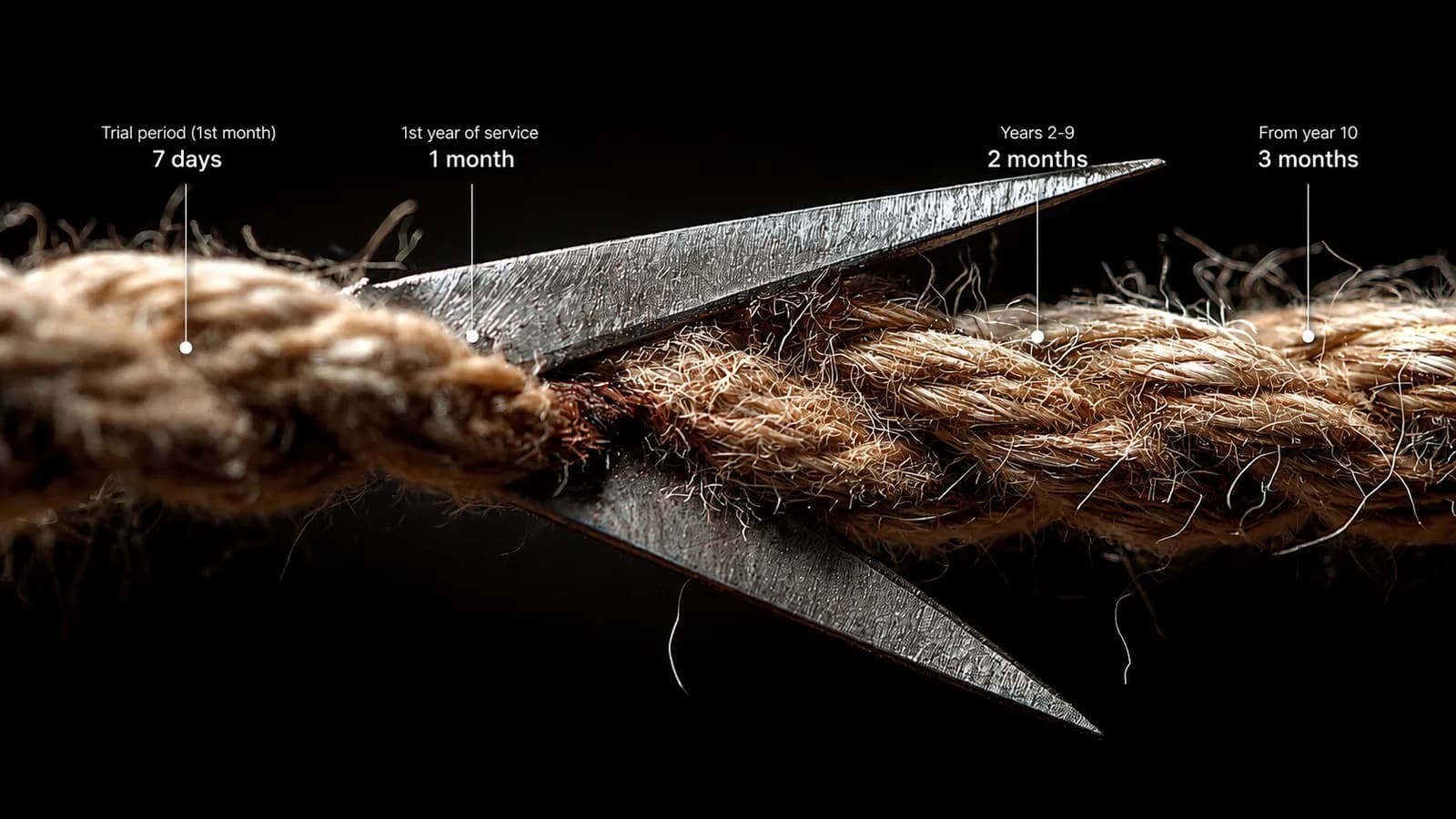
Minimum periods are governed by Art. 335b and 335c CO. They can only be extended equally for both sides - if your notice is two months, hers is too. Any such change during an ongoing employment needs her signature.
Statutory minimum periods (Art. 335b-335c CO)
The notice period starts the day after receipt of the termination and runs to the end of a calendar month. Example: you give one month's notice on 5 May - the employment ends on 30 June, not 5 June.
NAV domestic work & cantonal differences
The standard employment contract for domestic work (NAV) applies subsidiarily - only where you have no written contract. NAV notice periods usually match the CO minimums, but some cantons (e.g. Geneva, Ticino) have their own NAVs with deviations. What counts is the NAV of the canton where she works, not where you live. Check it if there is no written contract.
Tip
Form & writing - how to terminate
The CO does not prescribe a specific form for dismissal. You could in theory terminate verbally or by WhatsApp - and it would be valid. In practice this is a serious mistake, because in a dispute you must prove when the dismissal arrived. Without proof, the deadline shifts by weeks.
- •Registered letter with confirmation of receipt: The gold standard. The post office confirms the delivery date, which is legally robust. Important: the deadline starts on the day of effective receipt, not the day of posting.
- •Hand-delivered against signed receipt: Also works - have the cleaner sign the original with date. Keep a copy.
- •Email or WhatsApp: Legally valid but hard to prove in a conflict. Useful only as a supplement to the registered letter, never the sole channel.
- •Verbal: Avoid. In a conflict it is your word against hers, and you will likely lose.
What must the termination letter contain?
- ✓Date and recipient
- ✓Clear statement: "I hereby terminate the employment relationship ordinarily as of the next possible date."
- ✓Calculated end date (or reference to the next possible date)
- ✓Reference to the employee's right to ask for the reasons in writing (Art. 335 para. 2 CO)
- ✓Place, signature
A ready-to-use, legally vetted template is in our termination letter generator - with automatic deadline calculation.
Protection periods - when you cannot terminate
Art. 336c CO protects employees against dismissal in certain life situations. A termination issued during a protection period is null and void - it has no effect. You must reissue it after the period ends.
- •Illness & accident - 1st year of service: 30 days protection. 2nd-5th year: 90 days. From 6th year: 180 days. A medically certified incapacity for work is required. How long her pay continues is explained in the article on sick pay for household staff.
- •Pregnancy & maternity - Throughout the entire pregnancy and 16 weeks after birth. Longer than any other protection period - and absolute, regardless of years of service. What applies from the announcement to maternity leave is covered in the guide on employing a pregnant cleaner.
- •Military, civil or protection service - During mandatory military, civil or civil protection service; if the service lasts more than 11 days, additionally four weeks before and after (Art. 336c para. 1 let. a CO). Also applies to women called up in equivalent functions.
- •Aid mission abroad - When officially mandated to participate in an aid mission abroad with the employer's consent - rare, but provided for by law.
Period starting before protection
A termination during a protection period is null and void - not just contestable. You must reissue it after the period ends.
Wrongful dismissal - even correct form can be expensive
Even when you respect every formality and protection period, a dismissal can still be wrongful. Art. 336 CO lists the main cases:
- •Dismissal because of an inherent personal characteristic (e.g. religion, origin, sexual orientation) - unless related to the employment.
- •Dismissal because the employee asserted a claim in good faith (e.g. unpaid wages, holidays, protection period).
- •Dismissal for exercising constitutional rights (e.g. union membership, political activity).
- •Retaliatory dismissal after a legitimate sick notice or claim.
What a wrongful dismissal costs
The court sets the compensation at its discretion, based on the severity of the breach, length of employment, employee's social situation and employer's finances. The dismissal itself remains valid - the compensation is a penalty on top.
Warning

Step-by-step procedure
Household employee: exit sheet
Ordinary termination, CO art. 335
0 of 8 done
Clean dismissal - the right order
Final settlement
Reference, keys and deregistrations
Take it with you as an A4 PDF, with your ticks and your entries.
Download PDF
Enter your email address and download your document as PDF.
No spam. Unsubscribe anytime.
What you type here stays in your browser. Only the email address you leave for the PDF reaches us.
One tap: the message is ready.
›You stay in control: tap, copy, tweak, send.
Final pay & key handover
Due on the last working day: every open claim. A final settlement that misses items is the most common trigger of wage lawsuits. Mandatory positions:
- •Pay out unused holidays: Untaken holiday days are converted into cash (Art. 329d para. 2 CO). For a CHF 2,000 monthly salary, one holiday day is roughly CHF 92.30. Note: during the notice period you may order holidays, but only proportionally to the time remaining.
- •Pro-rata 13th salary: If contractually agreed: pay out proportionally. Example: departure on 30 June, 13th salary agreed, gross salary CHF 2,000 - due is 6/12 = CHF 1,000.
- •Overtime: Accrued overtime paid out with a 25% supplement, unless free time compensation was agreed (Art. 321c CO).
- •Withholding tax & social insurances: Show clearly on the final payslip. For a Swiss-based cleaner: AHV/IV/EO 5.3%, ALV 1.1% up to CHF 148,200, NBU premium charged to the employee.
- •Key receipt & work materials: Take back keys in person against a written receipt. Cleaning materials and equipment owned by the employer go back too.
- •Work reference: Mandatory without exception (Art. 330a CO) - even for a three-month employment. Full reference with assessment, or work confirmation without judgement. On request a full reference must be issued.
Common mistakes - and how to avoid them
Mistake 1: Verbal dismissal
"From next week, don't come back" over tea - legally valid but barely provable. If the cleaner contests the date, you must prove it. You can't.
Mistake 2: Ignoring protection periods
The cleaner is sick, you terminate anyway. The dismissal is null. If you don't notice and assume the relationship is over, you keep owing wages - often months until she files suit.
Mistake 3: Wrong notice calculation
Notice ends not on day X but on the end of the following month. Anyone who terminates a week late pays a full month longer.
Mistake 4: Immediate dismissal without good cause
"She broke a vase, that's enough." It isn't. You pay full salary until the next ordinary date plus compensation.
Mistake 5: Incomplete final pay
Forgotten holidays, no overtime supplement, no work reference - all common dispute points. A clean payslip automatically closes most gaps.
Mistake 6: Refusing the reference
No work reference means breach of Art. 330a CO. The employee can sue for it - and always wins.
Frequently asked questions
Do I have to give reasons for the dismissal?
No. For an ordinary dismissal you don't need to state any reasons (Art. 335 CO). If the employee asks in writing for the reasons, you must communicate them in writing. For an immediate dismissal, however, the good cause must be stated and proven.
What happens if I terminate during the probation period?
During probation a shortened notice of 7 days applies (Art. 335b CO). Protection periods under Art. 336c CO do not apply during probation. No reason is required - probation exists precisely to allow both sides to part without commitment.
Can I terminate while my cleaner is sick?
No. During medically certified incapacity, a protection period of 30, 90 or 180 days applies (depending on years of service). Any dismissal in this period is null. Wait until the period ends, then terminate ordinarily.
What notice applies if I have no written contract?
The statutory minimums of Art. 335c CO apply: 7 days in probation, 1 month in year 1, 2 months from year 2 to 9, 3 months from year 10. Your canton's NAV may apply subsidiarily - check the content.
Must I issue a work reference for the cleaner?
Yes, always. Art. 330a CO obliges every employer to issue, on request, a full reference (with assessment) or a work confirmation (without judgement). This applies to short employments and to the simplified billing procedure.
What's the worst-case cost of a wrongful dismissal?
Up to six months' salary in compensation (Art. 336a CO), in addition to normal pay. For a cleaner on CHF 2,000 gross, that's CHF 12,000 - plus lawyer and court fees. Condition: the employee must have filed written objection by the end of the notice period, then sue within 180 days.
§Sources & further information
All statements in this article are based on the following publicly available Swiss legal sources:
- 1CO Art. 335 - governs ordinary termination · fedlex.admin.ch ↗
- 2CO Art. 335b - termination during probation (7 days) · fedlex.admin.ch ↗
- 3CO Art. 335c - statutory minimum notice by years of service · fedlex.admin.ch ↗
- 4CO Art. 336 - defines wrongful dismissal · fedlex.admin.ch ↗
- 5CO Art. 336a - compensation up to 6 months' salary · fedlex.admin.ch ↗
- 6CO Art. 336b - objection by end of notice period, claim deadline 180 days after · fedlex.admin.ch ↗
- 7CO Art. 336c - protection periods (illness, pregnancy, service) · fedlex.admin.ch ↗
- 8CO Art. 337 - immediate dismissal for good cause · fedlex.admin.ch ↗
- 9NAV domestic work (SR 221.215.329.4) - subsidiary standard contract · fedlex.admin.ch ↗
Terminate safely - with the right tools
With Clino you keep contracts, notice periods and protection periods organised. Calculate the exact deadline with our notice period calculator.
Free Checklist: Hire Household Help Correctly
AHV, accident insurance, contract. All on one page, by email in 30 seconds.
No spam. Unsubscribe anytime.
Legal notice: This article provides general information about Swiss dismissal law for private households. It does not replace legal advice. Exact provisions may vary depending on the canton, contract and individual case. For disputes, consult a specialist. As of 2026, based on Art. 335-336c CO and the NAV for domestic work.